The article presents a brief portrayal of Ajay Piramal, juxtaposing his typically lauded “philanthropic” (CSR) efforts through the Piramal Foundation’s initiatives with a myriad of serious allegations suggesting misuse of influence and finances. Critics sometimes assert/allege that he orchestrated a questionable purchase of DHFL through a dubious IBC resolution process, which has led to potential court contempt issues. SEBI investigations into insider trading (2016, 2019) and irregularities in stake sales (2024) are also present with regard to Mr. Piramal’s business career. He is also reportedly connected to the Flashnet scandal and alleged environmental damage in Digwal, Telangana, where he purportedly sought and lost a stay order at the National Green Tribunal. Additional controversy arises from ₹85 crore in BJP donations through electoral bonds, purportedly exploitative real estate clauses, and a loan to Omkar Developers that prompted ED scrutiny—yet Mr. Piramal is said to have obtained legal protection. The narrative suggests that his political connections, particularly with the BJP, may have enabled him to repeatedly evade regulatory accountability, casting doubt on whether his philanthropic initiatives are intended to deflect criticism from these alleged financial improprieties. The article does not intend to defame or target the individual Ajay Piramal; rather, it seeks to highlight the potential implications of a corporate tycoon operating within a BJP-led crony framework in contemporary India.
DISCLAIMER:The allegations and claims outlined in this article are subject to ongoing judicial review and investigation, with many issues remaining sub judice. Readers should refrain from forming definitive conclusions due to the absence of conclusive evidence. OBMA has always mindfully used cautious and legally accurate language, employing terms such as “alleged,” “reported,” “possible,” and “supposed” when discussing matters related to Mr. Ajay Piramal and other business figures. We encourage readers to maintain an open-minded, critical, and independent perspective to foster a just and equitable society, challenging structurally induced constraints.
ParamavaiṣṇavaAjay Gopikisan Piramal, “grand philanthropist”, CBE, born August 3, 1955, is an Indian billionaire businessman and chairman of the Piramal Group, a conglomerate with interests in pharmaceuticals, financial services, real estate, and healthcare analytics. With a net worth estimated at $2.8 billion as of July 2024, Piramal has built a business empire over decades, starting in his family’s textile business and expanding through strategic acquisitions. He holds a bachelor’s degree in Science from the University of Mumbai, a master’s in management studies from Jamnalal Bajaj Institute, and attended Harvard Business School’s Advanced Management Programme in 1992. Despite his business acumen and CSR initiatives through the Piramal Foundation, Piramal has faced several allegations and reported/supposed controversies, primarily related to his business dealings, which are detailed below using cautious language as these claims remain subject to legal and public scrutiny.
Alleged/Reported/Possible Controversies
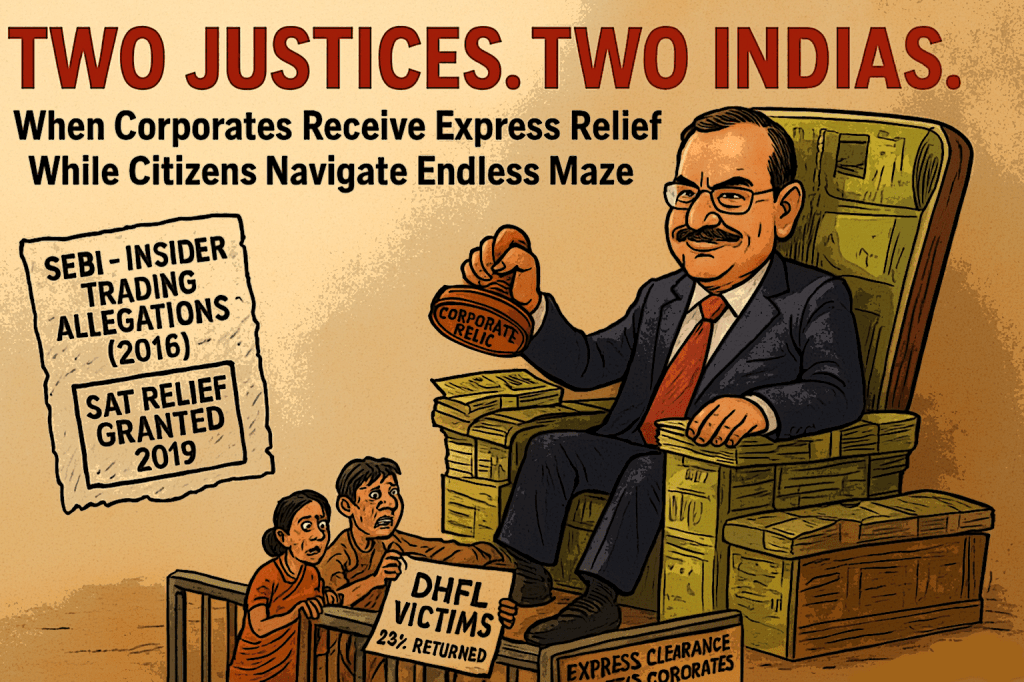
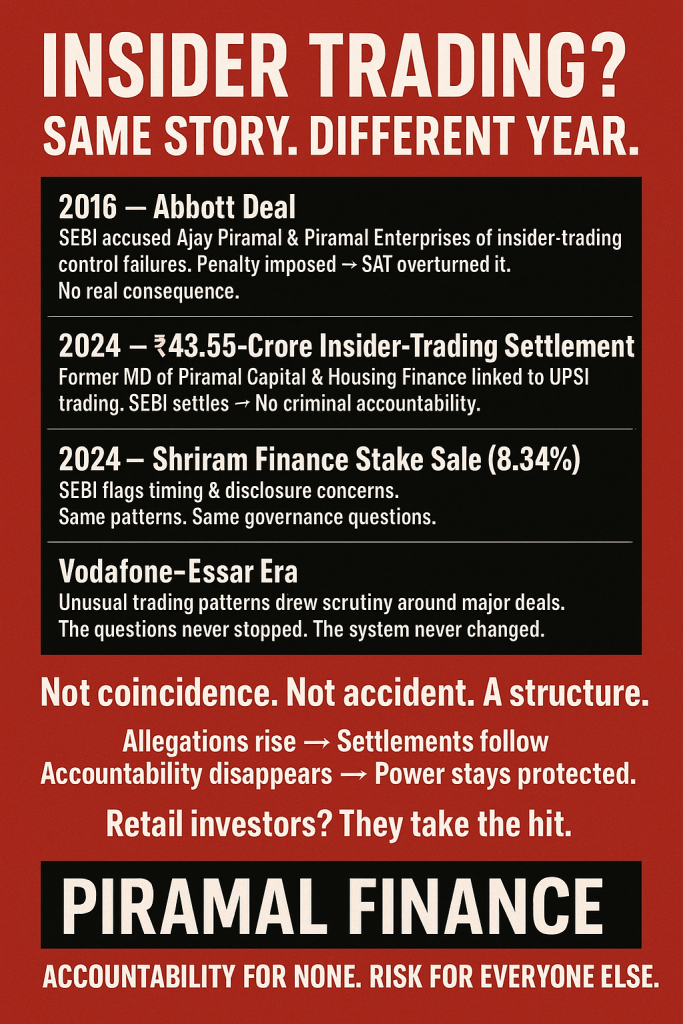
Piramal Finance’s history reflects a persistent pattern of insider-information lapses and regulatory impunity: In 2016, the Securities and Exchange Board of India (SEBI) reportedly accused Ajay Piramal and Piramal Enterprises of insider-trading violations linked to the $3.7-billion Abbott deal, imposing a fine of ₹6 lakh for alleged lapses in insider-trading controls. SEBI found that members of the promoter family — despite not holding formal positions — had access to unpublished price-sensitive information and that the trading window remained open during a sensitive transaction period. Although the Securities Appellate Tribunal (SAT) later set aside SEBI’s order in 2019 and provided relief to Piramal Enterprises, and no conclusive guilt was established, the episode heightened concerns about information-governance integrity. This was followed by one of the largest UPSI-linked settlements of the decade in 2024, where SEBI settled a ₹43.55-crore insider-trading case involving Khushru Jijina, former MD of Piramal Capital & Housing Finance, who allegedly traded Piramal shares based on insider information facilitated through a loan from the Piramal Welfare Trust. In the same year, SEBI flagged timing irregularities, disclosure asymmetry, and informational advantages during Piramal’s 8.34% Shriram Finance stake sale, echoing older fissures in governance architecture. Even earlier, during the Vodafone–Essar transaction period, SEBI scrutinised unusual trading activity involving entities linked to Piramal’s investment ecosystem. Seen together, these episodes suggest that Piramal’s insider-trading controversies are not isolated aberrations but part of a structural pattern where accountability is repeatedly deflected through SAT dilutions, regulatory settlements, and legal insulation — raising troubling questions for retail investors who lack comparable protections.
Environmental Violations in Digwal, Telangana (2018-2019): Piramal Enterprises (through various allegedly shell company games) faced accusations of environmental misconduct related to polluting activities in Digwal, Telangana. The National Green Tribunal (NGT) reportedly denied Piramal’s request for a stay order on environmental compensation, labeling the company’s actions as environmentally harmful. These claims have contributed to perceptions of Piramal as prioritizing business interests over ecological responsibility, though specific legal outcomes remain unclear.
Dahej 2026 – Acute Violation Pattern: On 30 January 2026, a tanker allegedly dumped spent hydrochloric acid from Piramal Pharma Limited’s zero-liquid-discharge Dahej fluorochemicals facility into a canal feeding the Narmada River, prompting the Gujarat Pollution Control Board to issue a closure order (3 Feb) and ₹1 crore penalty under the Water Act. The Supreme Court of India (9 Feb) refused interim relief, yet operations were restored by 13 Feb after GPCB revocation—allegedly reflecting a pattern of shutdown spectacle followed by swift restart with limited operational disruption.
Crony Allegations: Flashnet Scam (2018) and More: Mr. Piramal has been linked to allegations of quid pro quo with the Bharatiya Janata Party (BJP). Reports claim Piramal Group companies donated ₹85 crore to BJP via electoral bonds between 2019 and 2024, raising concerns about political influence, especially after the 2018 Flashnet scam allegations. The Wire reported that Piramal Estates Pvt Ltd purchased shares of Flashnet Info Solutions, owned by BJP Union Minister Piyush Goyal and his wife, for ₹48 crore in 2014, a 1,00,000% premium, shortly after Goyal’s appointment as a Union Minister. This transaction, alongside Piramal’s 2016 investment in Essel Green Energy while donating ₹28 crore to the BJP-favoring Prudent/Satya Electoral Trust in 2016-17, has fueled speculation of cronyism and conflicts of interest. Critics, including OBMA, allege these contributions and the DHFL acquisition reflect a nexus with BJP, though no definitive legal findings confirm these claims.
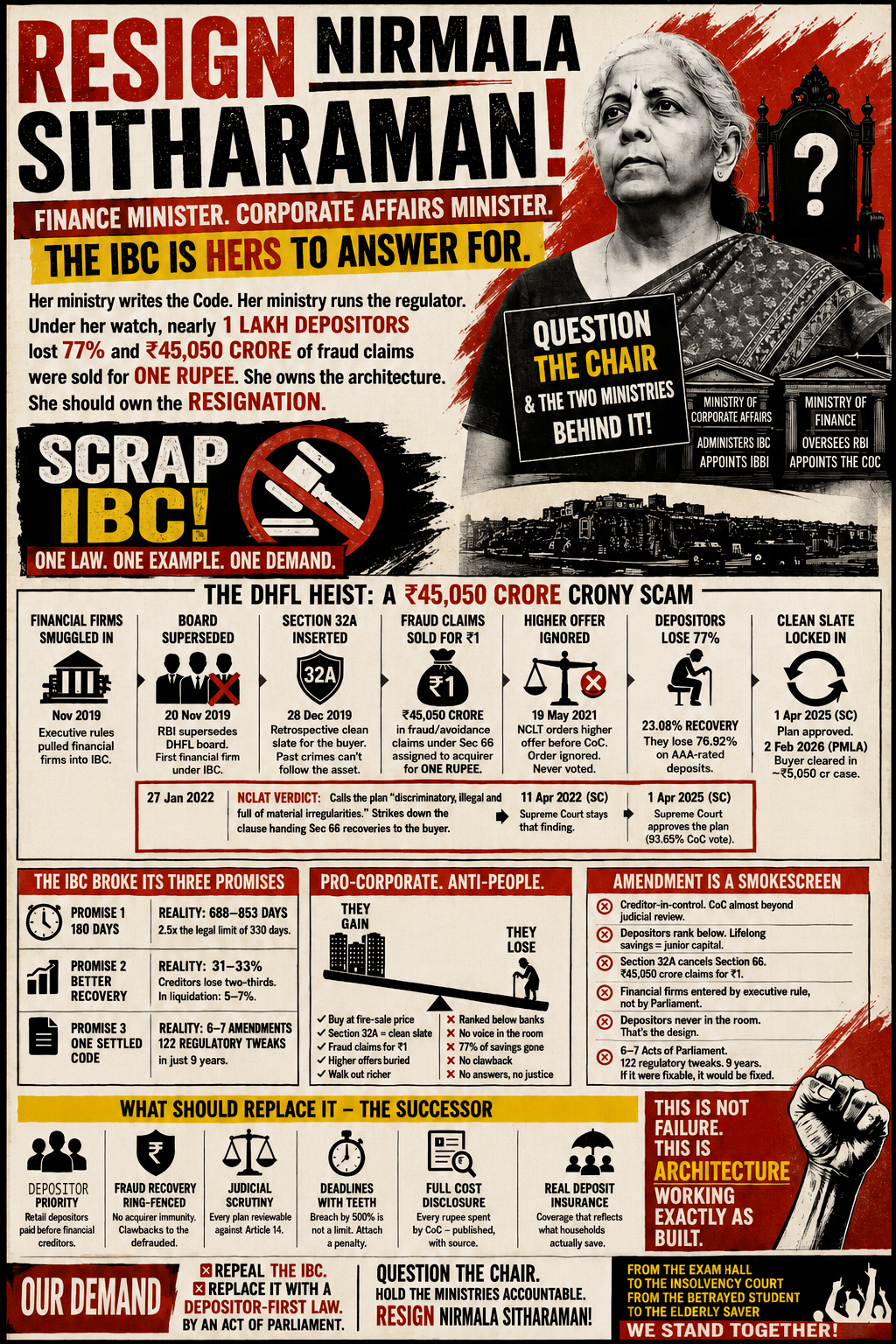
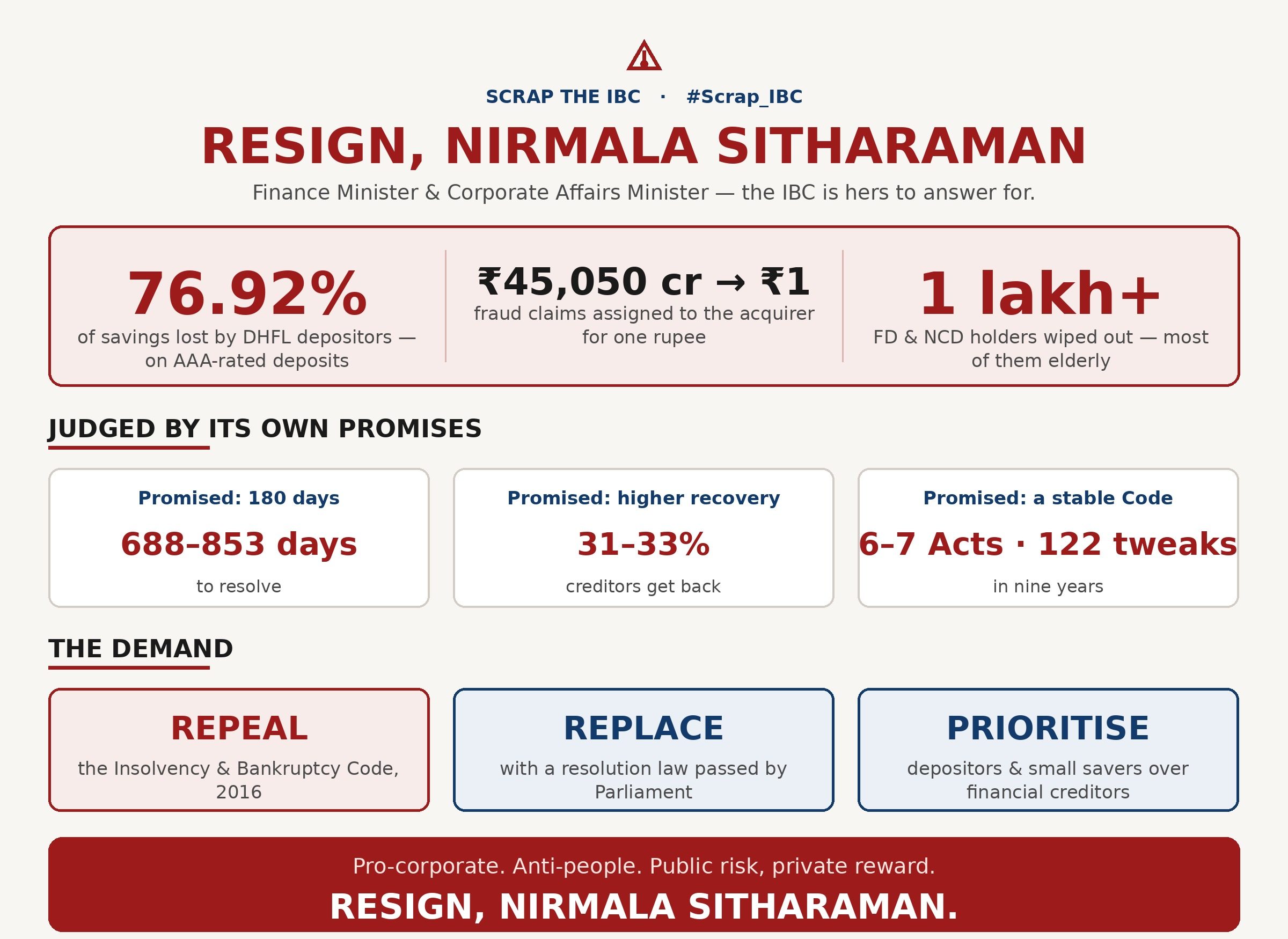
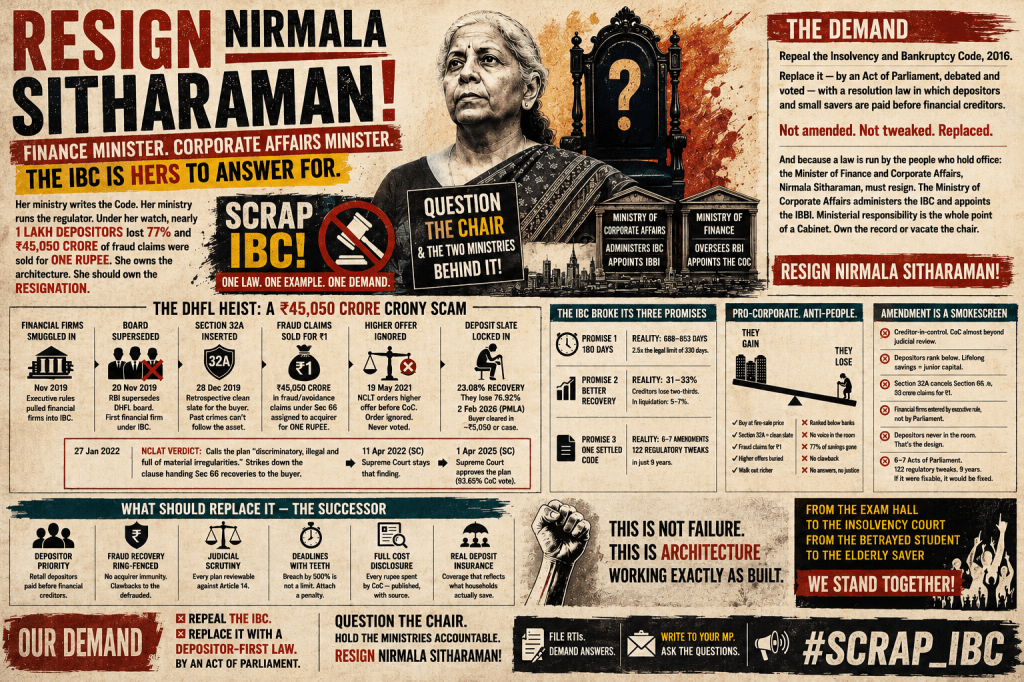
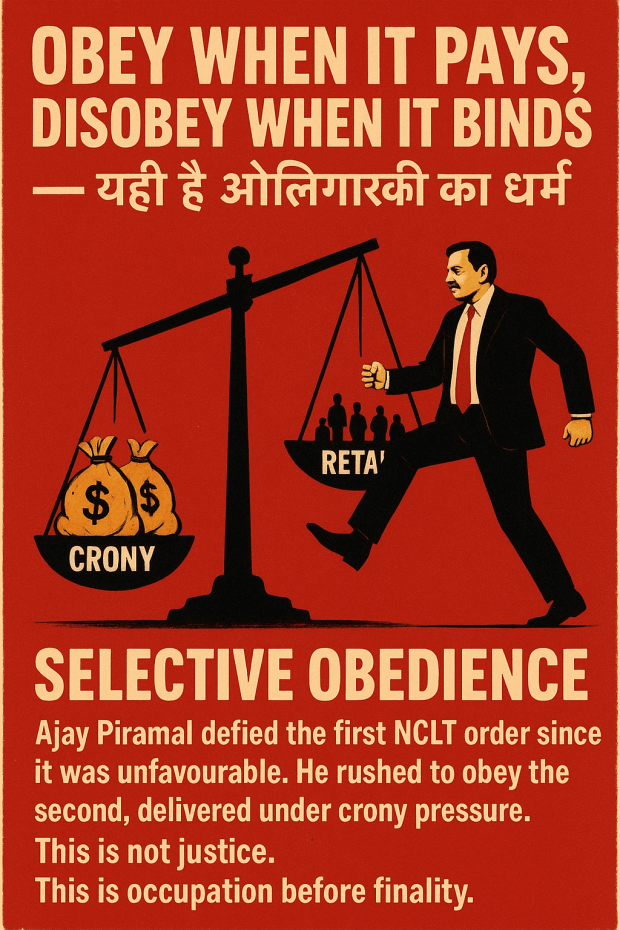
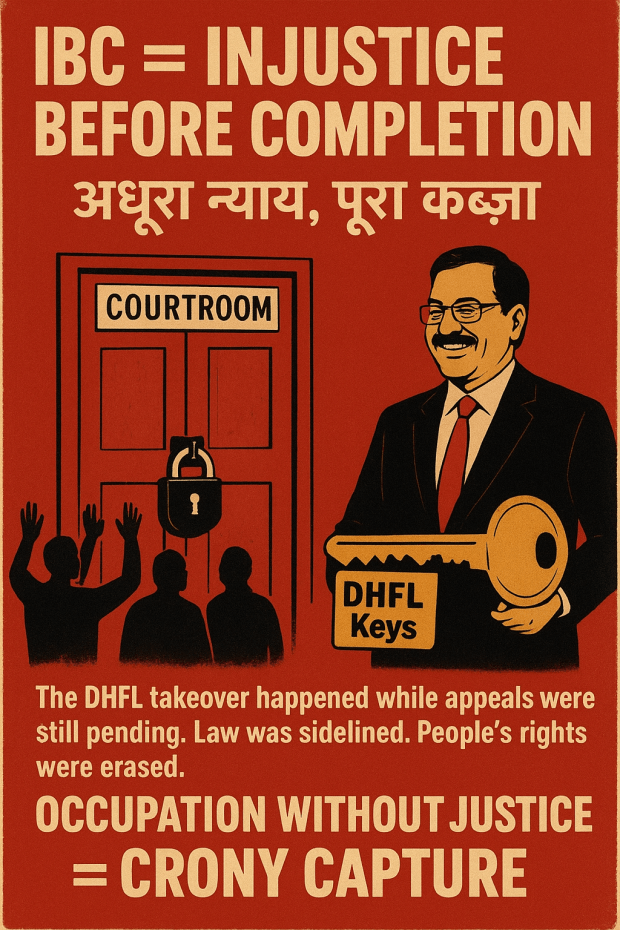
Dewan Housing Finance Corporation (DHFL) Acquisition (2021-2022): The acquisition of DHFL by Piramal Capital and Housing Finance Limited (PCHFL) for Rs. 34,250 crore, against a reported book value of Rs. 94,000 crore, has been a focal point of controversy. Some critics have alleged that Mr. Piramal secured DHFL at a significant discount (45k Crore assets for 1 rupee, as pointed out by the NCLAT in its 27th Jan, 2022 verdict), causing substantial losses for fixed deposit holders, non-convertible debenture (NCD) investors, and small stakeholders. The process reportedly defied orders from the National Company Law Tribunal (NCLT) on May 19, 2021, and the National Company Law Appellate Tribunal (NCLAT) on January 27, 2022, which declared the resolution plan irregular. Mr. Piramal allegedly secured stay orders, including one from the Supreme Court on April 11, 2022, to supposedly/possibly delay adverse rulings. Whistleblower claims suggest financial harm from discounted loans post-acquisition, with accusations of a nexus with the BJP and regulatory bodies like the Reserve Bank of India (RBI), pointing to crony capitalism. These claims remain under legal scrutiny, with no final adjudication conclusively confirming misconduct.
Loan Probe Involving Omkar Developers (2021): The Enforcement Directorate (ED) reportedly investigated a Rs. 2,000 crore loan from Mr. Piramal to Omkar Developers. Piramal’s assets later received protection from the Delhi High Court, raising questions about transparency and regulatory oversight. The investigation’s outcome remains unclear, but it has fueled speculation about Piramal’s financial dealings.
Shriram Finance Stake Sale (2024): SEBI reportedly flagged issues with Piramal Enterprises’ sale of an 8.34% stake in Shriram Finance, raising concerns about compliance with market regulations. While details are limited, this incident added to perceptions of regulatory challenges faced by Piramal’s business operations.
Alleged Harrassment and Legal Intimidation: Critics have sometimes accused Mr. Piramal of exploiting DHFL investors and using legal tactics, including defamation and contempt petitions filed through DSK Legal, to suppress freedom of speech in the form of democratic dissent. These actions allegedly target activists and whistleblowers to silence criticism of the DHFL acquisition. The use of legal measures has been cited as an attempt to supposedly obscure alleged misconduct.
Mergers and Rebranding as Evasion Tactics: Mr. Piramal has been accused of using rapid mergers, demergers, and company rebranding to evade accountability. For instance, the 2022 demerger of Piramal Pharma and the 2024 merger of Piramal Enterprises with PCHFL (renamed Piramal Finance) have been criticized as strategic moves to obscure past controversies, including the DHFL acquisition and environmental issues. These actions align with RBI’s 2025 NBFC listing mandate but have drawn scrutiny for allegedly prioritizing corporate restructuring over stakeholder interests.
Alleged Misuse of Religious Identity: Piramal, a follower of the Gauḍiya Vaiṣṇava tradition and devotee of Radhanath Swami, has been accused of hypocritically using religious principles (as masking) to justify business practices. Critics argue that his actions, particularly in the DHFL case, contradict the ethical tenets of his professed faith, though these claims are subjective and tied to public perception rather than legal findings.
Real Estate Dealings: Shadows of Possible Ecocide? Krishnaraj Rao and Siddarth Jaaju allege that Piramal Realty’s draft agreements, such as for Piramal Revanta Towers (possession 2023–2026), are one-sided, favoring PRL Developers Private Limited and limiting flat-buyers’ rights with skewed exit clauses and a misleading “Piramal Assurance.” Rao claims Piramal uses loophole-laden out-of-court settlements to evade accountability, deceiving buyers seeking legal recourse. Additionally, projects like Piramal Vaikunth, Piramal Mahalaxmi, and Piramal Revanta, located in low-lying Mumbai areas (e.g., Jacob Circle at 3 meters and Mulund at 11 meters above sea level), are criticized for ignoring ecological vulnerabilities. Critics, citing Henry George’s Progress and Poverty (1879) and Amitav Ghosh’s The Great Derangement, argue these developments profit from “unearned increment” in fragile zones, risking coastal flooding and biodiversity loss, contrary to the Mumbai Climate Action Plan’s focus on mangrove preservation and flood mitigation. These unproven allegations raise serious concerns about consumer exploitation and environmental ethics.
This brief video has been designed as a glitch-art digital scroll because the DHFL story itself is a tale of systemic malfunction — a system crashing in real time while the screen pretended everything was “resolving smoothly.” The distortions, broken code and digital noise are not aesthetic choices; they mirror the structural failures, judicial anomalies, political patronage and corporate engineering that enabled Piramal Finance (formerly PCHFL), backed by BJP-linked power circuits , to capture DHFL. The video maps each skipped step of justice: how responsibility was bypassed as Piramal entered the insolvency process as an empire-builder riding on government-enabled crony capitalism ; how, on 19 May 2021, the NCLT’s directive to reconsider Wadhawan’s 100% offer was instantly neutralized by the NCLAT on 25 May 2021 — a six-day judicial sprint that raised the first contempt-like breach, as the original order was effectively ignored under political pressure; how the IBC’s guiding spirit was upended when the NCLT, on 7 June 2021, approved Piramal’s plan while bypassing its own earlier directive; how accountability collapsed when the NCLAT’s damning judgment on 27 January 2022 — calling the plan “illegal, irregular, discriminatory” — was met with Piramal’s second contempt-like response, appealing on 1 March 2022 without addressing the irregularities; how the Supreme Court rushed in on 11 April 2022 to stay that judgment with suspicious speed; how, between 2022 and 2025, depositor pleas were dismissed, adjourned or buried while Piramal navigated the judiciary like a privileged corporate client shielded by ruling-party proximity; and how the ultimate rupture arrived on 1 April 2025, when a BJP-aligned bench upheld a resolution plan that returned only 23% and vapourised 77% of citizens’ life savings . By the time Piramal executed the 2025 reverse merger of erstwhile PEL — scrubbing audit trails, erasing cash-flow histories and shedding past liabilities — humanity itself had been deleted from the system. The glitch aesthetic, therefore, is not a style but a metaphor: a portrait of a country where corporate privilege runs on high-speed bandwidth , and citizen justice crashes under the weight of cronyism, political shielding, and institutional obedience.
Conclusion
Ajay Piramal’s business career seems to be filled with events, yet it has also been marked by several alleged controversies (like most corporate tycoons in crony situations), ranging from insider trading allegations and environmental violations to the supposedly contentious DHFL acquisition and regulatory scrutiny. While these allegations, derived from media house reports as secondary data, have sparked significant public and investor debate, many remain under legal review. Piramal’s purportedly strategic use of mergers and legal measures has further fueled perceptions of evading accountability. As these matters continue to unfold, they highlight the complex interplay of big business, regulation, and public perception in India’s crony landscape under BJP rule.
SEE ALSO:
View Selected Reviews on PEL from the Mouthshut Platform
In December 2025, India’s digital political landscape is dominated by the Bharatiya Janata Party’s (BJP) highly professionalized IT Cell, currently led by Amit Malviya, which functions as a vast, hierarchical apparatus blending centralized strategy, AI-driven tools, paid operatives, and massive volunteer networks to orchestrate continuous propaganda, narrative control, and disinformation campaigns across platforms like WhatsApp, X, YouTube, and Facebook. Widely criticized for systematically disseminating misinformation, deepfakes, clipped videos, communal hate speech (particularly anti-Muslim), and coordinated trolling that incites offline violence and vigilantism—while rarely retracting debunked claims—the IT Cell is accused of manufacturing consent, suppressing dissent through intimidation and surveillance-linked tools, and diverting public attention from economic precarity, unemployment, and governance failures via spectacle-driven “statue-temple nationalism” and pseudoscientific Hindutva myths. Operating symbiotically with “Godi media” owned by aligned corporates (Adani, Ambani), fueled by opaque funding and asymmetric ad spends, and enabled by regulatory gaps in AI oversight, data protection exemptions, and platform passivity, this “digital Leviathan” erodes epistemic trust, polarizes society, chills free expression, and contributes to democratic backsliding, even as independent fact-checkers (e.g., Alt News), civil society, and media literacy initiatives offer resilient counter-efforts against the routinization of information warfare in India’s platform-mediated public sphere.
0. Introduction: “Digital India” or Digital Leviathan?
As December 2025 nearly draws to a close, India’s digital political sphere (or the politics of cyberspace, to be precise) stands as one of the most intensively organized, contested, and consequential terrains of contemporary democracy. Central to this landscape is the Bharatiya Janata Party’s (BJP) Information Technology (IT) Cell, a specialized organizational apparatus formally instituted in 2007 and currently headed by Amit Malviya. Lauded by party supporters as a force in political communication and widely credited with shaping the BJP’s electoral successes since 2014, the IT Cell has simultaneously attracted sustained criticism for its alleged role in disseminating misinformation, amplifying communal and/or fundamentalist stereotypes—particularly against Muslims and free thinking citizens—and fostering online intimidation of journalists, artists, and political critics. Investigative reports by Indian and international media, including The Washington Post and Newslaundry, describe a vast, tiered digital network of the BJP IT Cell—extending from national to block levels and involving tens of thousands of paid volunteers and workers—designed to “capture the mind of the voter or citizen” through continuous messaging, WhatsApp mobilization with distorted news, and rapid narrative management as a whole.
The evolution of the BJP IT Cell mirrors a broader transformation in Indian politics, where social media, data analytics, and platform-driven affect have become integral to electoral strategy and state-corporate control. From early experiments with SMS campaigns and prerecorded calls in the 2004 election, to the systematic deployment of online forums, Twitter/X engagement in particular, and later, television channels such as NaMo TV run by the IT Cell itself, the BJP institutionalized digital outreach earlier and more aggressively than its rivals. Yet this consolidation of digital power has been accompanied by repeated controversies: arrests for inciting communal tensions through manipulated content, legislative concerns over the “mainstreaming of hate and intolerance,” and platform interventions such as Twitter’s 2020 decision to flag posts by the IT Cell head as “manipulated media.” Insider testimonies from former volunteers and cyber-workers further suggest a system in which misogyny, authoritarian-coercive thought control, Islamophobia, and coordinated trolling are not aberrations but structural features of political messaging as part of the BJP’s overall Hindutva agenda.
Against the backdrop of economic precarity, political polarization, social marginalization, and proliferating AI-enabled misinformation in India in 2025, the BJP IT Cell emerges not merely as a campaign tool but as a paradigmatic institution of contemporary digital domination—one that increasingly assumes the contours of a digital Leviathan operating under the veneer of a “Digital India”. Operating beyond the episodic rhythms of elections, this apparatus blurs the line between political communication, ideological mobilization, and information warfare by building a permanently active, omnipresent, indoctrinating narrative environment rather than engaging in conventional persuasion. Its power lies not only in its unprecedented scale and discipline but in its capacity for temporal saturation: to pre-empt facts, flood platforms with irrational campaigns, and render dissent reactive, defensive, or suspect. While other parties also operate IT Cells and engage in online mobilization, the BJP’s digital apparatus remains unparalleled in its ability to fuse volunteer networks, platform logics, and executive messaging into a continuous communicative machine in the age of “post-truth”.
Understanding its origins, methods, and impacts is therefore essential to any serious assessment of how democracy, dissent, and truth itself are being reconfigured in India’s platform-mediated public sphere. The emergence of this digital Leviathan signals a shift from deliberative politics toward environment-building governance, where power no longer relies primarily on consent secured through sustained argumentation or open-ended logical debate but on informational pre-emption and narrative enclosure. In such a system, misinformation does not merely distort facts; it exhausts the very conditions of verification, normalizing uncertainty and plausible deniability. The deeper democratic risk lies not simply in the spread of falsehoods through “fake news” or misleading data figures, but in the erosion of epistemic trust itself—where truth loses political traction, dissent is framed as deviance, and democratic contestation survives formally even as its substantive foundations are steadily hollowed out.
1. Origins and Structure: From Grassroots Mobilization to a Professionalized Digital Operation
The Bharatiya Janata Party’s (BJP) Information Technology (IT) Cell traces its roots to the late 2000s during Narendra Modi’s tenure as Gujarat Chief Minister, where early digital initiatives leveraged email lists, SMS campaigns, and online platforms to promote government schemes and counter opposition narratives, often in alignment with highly destructive RSS and/or Sangh networks. By 2013-2014, ahead of the national elections, it formalized under a national structure, contributing to the party’s extensive social media outreach. Following the 2014 victory of the BJP, the cell professionalized further, with Amit Malviya appointed as head in subsequent years, overseeing coordinated smear campaigns on platforms like X (formerly Twitter), WhatsApp, Youtube, Facebook and others.
While blind supporters credit the IT Cell with voter mobilization and narrative amplification, critics legitimately allege that it disseminates divisive content by foregrounding forceful obedience. Exact operational scales—such as assertions of a 5,000-strong paid core receiving fixed stipends, or a hierarchically coordinated force of 1.5–2 million “digital soldiers” operating across thousands of WhatsApp and Telegram groups—remain empirically unverified, yet constitute grave and unresolved concerns warranting sustained scrutiny. The cell relies on a mix of central staff, state-level coordinators, and vast volunteer networks for hashtag trends, content sharing, and rapid responses.
In recent years, including the 2024 Lok Sabha elections and 2025 state polls (e.g., Bihar), political campaigns across India have increasingly incorporated AI tools for personalized messaging, voice clones, chatbots, and video content in regional languages. Deepfakes have featured prominently in these operations, including resurrected avatars of deceased leaders for endorsements, robocalls, and manipulated clips, raising disinformation concerns.
The structure operates hierarchically: a national hub in Delhi for overarching strategy and high-profile campaigns (e.g., heavy digital ad spends on Google and Meta), state units for localized outreach, and district-level volunteers for ground-level amplification via apps and groups. This mirrors global digital political operations but within India’s multi-party context, where opposition groups also maintain active social media cells.
Table 1- Structural Layers and Key Functions (2025 Context)
Layer
Key Functions
Scale & Tech Integration
Examples/Case Studies
Analysis & Implications
National Hub (Delhi)
Central strategy, content creation, trend monitoring, ad management
Core team; AI tools for messaging and analytics
Nationwide campaigns like election ads; rapid responses to news
Enables coordinated narratives; raises concerns over reach asymmetry
Hundreds per state; integration of chatbots and voice AI
Bihar 2025 campaigns with dialect-specific robocalls; state-specific hashtag drives
Adapts to local issues; potential for amplifying divisions if content is polarizing
District/Grassroots Volunteers
Amplification, reporting opposition posts, voter outreach
Thousands of volunteers or paid cyber-workers; WhatsApp/Telegram groups
Door-to-door app-based data collection (e.g., Saral); trending local issues
Boosts grassroots penetration; risks of uncoordinated misinformation or trolling
This evolution reflects broader trends in digital campaigning, with AI lowering barriers for content creation but heightening risks of data/information manipulation enabled by the people in power. Parallels exist with international operations (e.g., data-driven targeting), but India’s scale—combined with platform dependencies—underscores the need for transparent regulations, fact-checking, and media literacy to mitigate societal polarization without stifling legitimate political expression or opposition’s voices through the use of slangs without argumentation. Independent critical oversight remains key to distinguishing coordinated outreach from systemic abuse.
2. Why It Persists: Ideological Reinforcement Amidst Mounting Backlash and Democratic Backsliding
The endurance of highly polarized digital political operations in India through those associated with the BJP IT Cell can be attributed to a combination of ideological commitments (Hindutva + cronyism + monopoly capitalism), strategic responses to socio-economic pressures, institutional enforcement gaps, and structural advantages in resources and platform reach. While supporters view robust online mobilization as essential for promoting supposed national “development” agendas and countering opposition critiques, it could indeed be argued that it reinforces majoritarian or theocratic narratives, labels dissent as unpatriotic (or questioning/criticizing BJP the party or Modi the proper name becomes equated with disloyalty to nation or country!), and exacerbates social divisions by closing the universes of discourses without due substantiation.
Documented increases in hate speech have ignited debates, particularly with the BJP targeting Muslims, often during political or religious events in BJP-ruled states. Human Rights Watch‘s 2025 World Report emphasized that the inflammatory rhetoric during campaigns has exacerbated risks of discrimination and violence.
Table 2- Key Factors Contributing to Persistence
Factor
Description (2025 Context)
Examples/Evidence
Analysis & Implications
Ideological & Political Alignment
Strong messaging around development (“Viksit Bharat”) and national security; framing critics as disruptive
Campaign rhetoric on infiltrators or urban Naxals; mutual across parties
Reinforces voter bases but risks polarizing discourse; incitement concerns
Socio-Economic Pressures
Narrative deflection amid challenges like regional conflicts or job markets
Manipur updates; economic recovery data
Political communication often prioritizes unity themes; can exacerbate tensions if divisive
Institutional Enforcement Gaps
Limited penalties for violations; laws applied to critics and fact-checkers
Sedition-equivalent charges against journalists; ECI advisories on AI misuse
Creates perceived impunity; chills free speech while platforms struggle with moderation
Enables greater amplification; common globally for incumbents, but transparency needed
Counter-efforts persist through fact-checkers like Alt News (at least hundreds of debunks already), civil society monitoring, and regulatory proposals (e.g., MeitY AI guidelines). Long-term risks include deepened polarization and eroded trust, often termed “democratic backsliding” in global analyses. Sustainable reforms—stronger enforcement of AI labeling, electoral funding transparency via ADR recommendations, independent platform oversight, and cross-partisan media literacy—offer pathways to mitigate harms while preserving vibrant political expression. Collective action across stakeholders is essential to safeguard pluralism in an increasingly digital democracy. The semantics of “democracy” as such ultimately signifies open dialogue. BJP IT Cell’s operations halt such dialogues from happening in the first place.
Mr. Hiren Joshi, Officer on Special Duty (Communications & Information Technology) in the Prime Minister’s Office since 2019, has come to symbolize the BJP’s shadowy capture of India’s media ecosystem. Multiple journalistic investigations portray Joshi as a key architect and enforcer of the party’s centralized narrative control—operating as a conduit between the PMO and pliant newsrooms, reportedly using WhatsApp groups to dictate headlines, suppress inconvenient stories, and synchronize talking points across television, print, and digital platforms. His role underscores how the BJP has replaced independent journalism with command-and-control messaging, collapsing the distinction between government communication and party propaganda. In late 2025, Joshi’s sudden disappearance from these channels triggered widespread speculation of an internal rupture within the PMO’s media-management machinery, with opposition leaders interpreting it as evidence of factional conflict or tactical retreat amid mounting scrutiny. His subsequent reappearance in key WhatsApp groups only reinforced concerns about the durability of this parallel, unaccountable system—one that critics argue Joshi helped build from the ground up, granting the BJP disproportionate, opaque, and profoundly anti-democratic influence over headline-setting and narrative priorities in India’s public sphere.
3. How It Operates: Hierarchical Networks and Outreach
As noted earlier, the BJP IT Cell operates through a layered system that blends centralized strategy with decentralized amplification: national teams in Delhi shape messaging, monitor trends, and fund platform advertising; state units localize content; and grassroots networks—largely coordinated via WhatsApp and such digital apps—push hashtags, shares, and voter outreach. This professionalized model combines paid staff with volunteers.
By 2025, AI integration has radically reshaped electioneering across India’s political spectrum. Campaigns increasingly deploy low-cost generative tools for hyper-local content production in regional dialects, AI-driven chatbots for voter engagement, voice cloning, synthetic video, and automated personalization at scale. These technologies have enabled round-the-clock propaganda, micro-targeted misinformation, and emotional manipulation with unprecedented speed and deniability. In response, the Election Commission of India (ECI) issued advisories mandating the labeling of AI-generated content and warning against misuse during electoral contests, including state elections such as Bihar’s, where AI-powered robocalls, deepfake videos, cloned voices, and algorithmically tailored messages proliferated widely. Deepfakes ranged from fabricated endorsements by living leaders to posthumous voice cloning of deceased figures, blurring ethical and legal boundaries. However, the ECI’s interventions remained largely procedural and reactive, exposing a widening gap between regulatory intent and enforcement capacity. Critics argue that such advisories functioned more as performative safeguards than effective deterrents, especially amid parallel allegations of “vote chori”—including opaque voter-roll revisions, selective enforcement of the Model Code of Conduct, delayed disclosures, and institutional silence on technologically mediated manipulation. In this context, AI-driven campaigning has not merely outpaced regulation; it has deepened existing anxieties about electoral integrity, regulatory capture, and the erosion of democratic trust under an increasingly compromised oversight regime.
Transnational information warfare becomes most visible during moments of crisis, and the April 2025 Pahalgam terrorist attack in Kashmir—resulting in civilian deaths and a sharp escalation of India–Pakistan tensions—was no exception. In its aftermath, social media was rapidly flooded with disinformation: recycled war footage passed off as current, deepfakes, fabricated intelligence leaks, false-flag insinuations, and hyper-nationalist incitement. What was striking was not merely the cross-border circulation of such material, but how seamlessly the BJP’s domestic propaganda machinery absorbed and amplified it, converting grief and fear into narrative weaponry. Rather than exercising restraint or safeguarding informational integrity, the ruling party’s digital ecosystem thrived on escalation, blurring fact and fiction to manufacture consent and foreclose democratic questioning. The episode exposed a broader global vulnerability to disinformation, but it also laid bare the BJP’s preferred crisis-response model: securitize the public sphere, delegitimize skepticism as treachery, and allow algorithmic outrage to substitute for accountability—at home and beyond national borders.
Table 3- Functional Categories of AI Deployment
Objective
Outcome
Examples (2025 Context)
Linguistic Bridging
Translate and dub content into regional languages
AI-dubbed speeches of leaders like Modi in multiple dialects; used across parties in Bihar polls
Historical Necromancy
Revive deceased figures for endorsements
Deepfakes of late leaders; cross-party instances in elections
Personalized Micro-Targeting
Deliver tailored voice messages or chatbots
Robocalls with cloned leader voices in Bihar, reaching millions cost-effectively
Narrative Sabotage
Create compromising or misleading content of opponents
Manipulated clips of figures like Kejriwal or Rahul Gandhi; mutual accusations in campaigns
These mechanics are not incidental by-products of technological change; they are integral to a political strategy perfected by the BJP IT Cell. AI has not merely lowered production barriers—it has industrialized persuasion, allowing the ruling establishment’s digital machinery to flood the public sphere with synthetic speech, deniable misinformation, and hyper-targeted emotional triggers at a scale no opposition formation can plausibly match. What is often described as “innovative outreach” in cases such as Bihar is, in practice, the routinization of automated propaganda: cloned voices, AI-dubbed messaging, chatbot-driven voter contact, and algorithmic amplification operating through dense WhatsApp and Telegram ecologies curated by the BJP’s digital command structure. The Pahalgam crisis further exposed how this apparatus thrives on emergency—rapidly folding cross-border disinformation, nationalist outrage, and securitized narratives into a domestic propaganda loop that delegitimizes dissent as disloyalty. Even unverified claims about vast digital “war rooms” acquire political force precisely because the BJP IT Cell’s opacity, scale, and past practices have destroyed baseline trust; secrecy itself becomes evidence. In this environment, unchecked AI deployment does not simply polarize society—it actively dismantles pluralism by eroding any shared epistemic ground, replacing democratic contestation with permanent information warfare. The Election Commission’s advisory-heavy, enforcement-light posture has effectively ceded the field, while platforms profit from engagement and legacy media launder coordinated narratives into legitimacy. The result is not a technologically advanced democracy, but a managed electorate—where elections persist in form while consent is algorithmically manufactured and accountability systematically evaded.
4. Funding the Hate-Intolerance Machine
Political party funding in India—including that of the Bharatiya Janata Party (BJP)—is formally reported as being directed toward declared heads such as election campaigns, propaganda, advertising (including digital), travel, and organizational activities, as submitted to the Election Commission of India (ECI) and periodically analyzed by bodies like the Association for Democratic Reforms (ADR). Yet this formal accounting tells only part of the story. Beneath these disclosures operates the BJP IT Cell, a centrally coordinated digital apparatus that has moved far beyond routine outreach to become a relentless engine of disinformation, misinformation, fake news, and targeted hate. Repeatedly documented in investigative journalism and insider testimonies, this machinery has been used to intimidate dissenters, vilify minorities, harass journalists, and delegitimize opposition figures—manufacturing consent while systematically suppressing criticism.
Although official audits obscure operational specifics, consistent insider accounts describe a hybrid digital army sustained by vast, opaque propaganda budgets: salaried professionals, per-project contractors, and incentivized volunteers working in tandem. Circulating reports speak of monthly stipends for core operatives—often cited in the range of ₹15,000 to ₹40,000—alongside task-based payments, from a few thousand rupees for coordinated trending campaigns to significantly higher sums for viral video production and narrative seeding. Beyond cash, in-kind rewards—jobs, government contracts, political access (to be in private parties with PM Modi), and protection—are widely alleged to function as informal compensation mechanisms. This ecosystem becomes especially visible during high-stakes moments, from elections to spectacles like the Ram Mandir inauguration, when manipulated videos, glorification of police violence, and anti-Muslim conspiracy narratives are pushed at scale through WhatsApp, X, YouTube, and regional platforms. Taken together, these repeated claims, insider disclosures, and observable patterns point not to isolated excesses but to a normalized model of digital warfare—one sustained by financial opacity, institutional impunity, and a ruling party’s willingness to convert state power, money, and technology into permanent information dominance.
In FY 2023-24, the BJP reported total expenditures exceeding ₹2,212 crore, with over ₹1,755 crore allocated to “election campaigns and general propaganda”—categories that encompass digital advertising, social media promotion, and related infrastructure, providing the financial backbone for the IT Cell’s disinformation blitz. For the 2024 Lok Sabha elections, the party spent approximately ₹1,494 crore overall, accounting for nearly 45% of total national party election spending. Digital platforms featured prominently: In 2024 alone, BJP expenditures on Google ads exceeded ₹39 crore for over 80,000 ads, with similar patterns on Meta. State-level examples, such as Bihar and Delhi 2025 polls, show BJP leading in platform ad spends (e.g., ₹4.6 crore in Bihar), dwarfing opposition efforts and enabling asymmetric dominance in spreading fake news and hate.
These funds underwrite not merely professional digital infrastructure—analytics dashboards, content studios, paid advertising, and salaried staff, with senior national- and state-level operatives reportedly earning as much as ₹1.5–2 lakh per month—but a far more pernicious ecosystem engineered for political intimidation and mass deception. Investigative reports and former insider accounts consistently describe a centralized command structure, with a core team in Delhi setting daily agendas that are rapidly cascaded through an enormous WhatsApp-based distribution architecture running into the millions of groups nationwide. Within this system, recycled protest footage is routinely recirculated as evidence of fresh violence, doctored images are used to brand opponents as “terrorist sympathizers,” and communal dog-whistles—particularly anti-Muslim rhetoric—are deliberately injected into high-visibility campaigns, including Ram Temple–related messaging, to polarize voters and inflame social tensions.
Former BJP digital operatives and journalists who have tracked the IT Cell’s functioning describe a deliberately deniable “volunteer army” of so-called yodhas (warriors), allegedly coordinated through centralized digital command hubs such as the National Digital Operations Centre (NDOC). While these volunteers are not always paid directly in cash—precisely to preserve plausible deniability—they operate within an incentive structure of political access, career advancement, protection, and proximity to power. This network has repeatedly been implicated in coordinated harassment campaigns: issuing rape and death threats to public figures, journalists, and critics; unleashing communal abuse against minorities; and smearing dissenters through synchronized trolling. Targets have ranged from actors like Aamir Khan to journalists such as Barkha Dutt, and even establishment figures like industrialist Rahul Bajaj, who was aggressively trolled and branded “Congress-linked” after publicly warning of a climate of fear under the Modi government.
The BJP IT Cell’s methods are further amplified by senior party figures—most visibly Amit Malviya—who routinely circulate selectively edited videos, decontextualized quotes, and conspiracy-laden clips that then cascade downward through party networks. Critics note a consistent pattern: once a false or misleading claim is released, it is never formally withdrawn, even after debunking. This “peddle fake, never delete” doctrine was evident in episodes such as the deliberate misrepresentation of Yogendra Yadav’s comments on alleged #VoteChori, twisted to insinuate admission of fraud in order to shield the Prime Minister and discredit electoral criticism.
Taken together, these report-based patterns point to something more systematic than rogue trolling or excess zeal. They reveal a ruling party’s digital apparatus that treats disinformation, intimidation, and communal provocation as routine political instruments—normalizing online vigilantism and eroding democratic discourse itself. In this model, propaganda is not a campaign tactic but a governing principle, sustained by financial opacity, institutional indulgence, and the strategic fusion of party machinery with platform algorithms.
While opposition narratives and online discourse routinely point to a centrally funded, paid troll army, the 2025 disclosures and analyses by the Association for Democratic Reforms (ADR) remain unable to penetrate the deliberate opacity surrounding these operations. No meaningful line-item disclosures exist for platform-specific spending, coordinated digital influence, or disinformation campaigns, despite repeated demands for granular transparency. This accounting vacuum is not accidental: it functions as a shield, obscuring how thousands of crores in political funding are converted into a propaganda juggernaut that manipulates electoral behavior, normalizes hate speech, intimidates critics, and drowns out independent journalism. In the absence of enforceable digital transparency, formal compliance becomes a ritual rather than a safeguard, allowing democratic distortion to proceed under the cover of legality while truth-tellers are systematically marginalized.
Table 4
Expenditure Category (Recent Examples)
Approximate Amount (₹ Crore)
Context/Allocation
Link to Digital/IT Operations
Election Campaigns & General Propaganda (FY 2023-24)
1,755
Largest BJP outlay; includes ads and outreach
Funds digital content, trends, and platform buys fueling IT Cell’s disinformation and hate campaigns
Google Ads (2024 Lok Sabha Period)
39+
Over 80,000 ads
Direct amplification of fake news and manipulated narratives via transparency-tracked channels
Total Election Spending (2024 LS)
1,494
45% of national total
Encompasses social media, apps, and coordinated troll operations for asymmetric reach
State Polls Digital Ads (e.g., Bihar/Delhi 2025)
4-88 (varies)
Platform-specific
Supports localized IT efforts in spreading misinformation; highlights spending asymmetries vs. opposition
In essence, while verified funds are formally routed to “propaganda” and digital advertising, the surrounding opacity—reinforced by documented payments, incentives, and a vast volunteer troll ecosystem—reveals how the BJP’s financial war chest sustains a toxic machinery of disinformation, fake news, and hate speech. Much of the grassroots malice is driven by incentivized “volunteerism,” lubricated through access, contracts, and political patronage, while the ruling party’s resource advantage enables scale without restraint. Without real-time ECI disclosures, platform-level audits, and mandatory breakdowns of digital propaganda spending, this veil will persist—allowing the BJP to bankroll informational poison, entrench majoritarian dominance, and further corrode India’s democratic foundations.
5. Tactics of Mis- & Dis-information: Logical Fallacies and Narrative Warfare
By 2025, India’s digital political sphere has been saturated with sophisticated disinformation practices in which manipulated media, selective editing, and logical fallacies function as core instruments of narrative warfare. Although aggressive online campaigning spans parties, the BJP IT Cell—operating under the public leadership of Amit Malviya—has attracted sustained, evidence-based criticism for the systematic amplification of misleading content, frequently without correction or deletion even after formal debunking. Independent fact-checking organizations such as Alt News and BOOM have documented a recurring pattern: clipped videos stripped of context, false attributions, recycled imagery, and AI-generated or AI-assisted fabrications engineered to exploit emotional triggers. This persistent distortion corrodes public trust and contributes to real-world polarization, with multiple studies linking amplified online hate speech to spikes in offline intimidation and violence.
Recent years, culminating in 2025, reveal a persistent playbook of disinformation orchestrated by the BJP IT Cell. Documented examples illustrate systematic manipulation:
South African Greeting as “Bowing to Modi”: Images falsely framed as South Africans “falling to the ground” for PM Modi, exploiting nationalism; the gesture was a traditional Venda greeting (u Losha).
Kanhaiya Kumar “Not Voting”: Photo misrepresented Congress leader’s voting behavior; he voted in Bihar.
Sonam Wangchuk “Inciting Violence”: Clipped video falsely suggested advocacy of violent protests; full video promoted non-violence.
Sonam Wangchuk “Hiding Identities”: Edited clip claimed masking advice was for concealment; context was health precautions.
Bangladesh Vigil as Kolkata Protest: Candlelight vigil from Dhaka misattributed as Indian protest.
Andhra Waqf Board “Abolished”: Claim that Naidu government abolished the board; only a prior order was revoked.
Rahul Gandhi “Ending Bharat Jodo Yatra”: T-shirt reference misrepresented as ending the march.
Rahul Gandhi “Refusing Turban”: Video claimed off-camera refusal to don a turban; baseless.
Rahul Gandhi “Issues with Priests”: Clipped press conference distorted meaning.
Unrelated Crowd as Modi’s Rally: Video of unrelated gathering passed off as PM’s event.
These cases demonstrate selective editing, false equivalence, and communal dog-whistling. Fact-checkers like Mohammed Zubair have repeatedly released full videos, translations, and sources, yet amplification of falsehoods consistently outpaces corrections. The IT Cell’s refusal to delete debunked posts—captured in the “peddle fake, never delete” ethos—ensures persistent influence over public perception. Critically, this machinery prioritizes narrative dominance over accuracy, shielding BJP scandals while branding dissenters as “anti-national,” undermining informed discourse, inciting vigilantism, and risking offline violence.
5.1. Inciting Division: Triggering Riots, Pogroms, and Vigilantism
Disinformation in India’s polarized digital ecosystem has repeatedly bridged online hate and offline violence, radicalizing mobs, justifying vigilantism, and exacerbating communal fractures. While misinformation circulates across political lines and complex socio-economic factors often underlie conflicts, documented patterns show inflammatory false narratives—amplified by political actors and supporters—playing a catalytic role in triggering riots, lynchings, and pogroms. The 2024 documentation of 1,165 hate speech incidents—a 74.4% surge—linked many to political events in ruling party states, though causation involves broader rhetoric and local dynamics.
Critically, BJP-affiliated accounts, including IT Cell head Amit Malviya, have faced scrutiny for sharing misleading content that inflames tensions, often without retractions. This “never delete” approach allows falsehoods to fester, contributing to real-world harm amid impunity gaps.
Granular Cases and Patterns
Manipur (2023-2025): Ethnic violence saw viral disinformation—fake videos, “infiltrator” claims, recycled footage—fueling clashes, with over 260 deaths and mass displacement. Mutual accusations amplified divisions.
West Bengal (2024-2025): Localized clashes involved morphed videos and fake narratives sparking FIRs and riots.
Northeast: Beef smuggling rumors led to mob attacks on Muslim farmers and migrant workers.
Pahalgam (2025): The April attack triggered bilateral disinformation surges, including deepfakes and false-flag claims.
Table 5- Case Study of Disinformation-Linked Violence
Trigger (Misinformation Example)
Outcome
Role of Amplification/Analysis
Muzaffarnagar Riots (2013)
62+ deaths (mostly Muslim), 50,000+ displaced
Fake Pakistan video shared by BJP MLA; instrumental in sparking riots
Delhi Riots (2020)
53 deaths (mostly Muslim), targeted attacks
Clipped/edited videos portraying protesters as violent
These incidents reveal a dangerous pattern: Falsehoods—often communal—radicalize groups, framing minorities as threats and justifying violence. While direct state sponsorship lacks proof, amplified disinformation by ruling party affiliates creates permissive environments for vigilantism, with slow moderation and rare accountability eroding the social fabric.
The implications are profound: When political machinery prioritizes division over truth, disinformation doesn’t just distort—it kills, displaces, and entrenches majoritarian hegemony. Establishing causation is complex, but the recurrence demands scrutiny: Stronger platform enforcement, criminal penalties for incitement, and political restraint. Without dismantling this cycle, India’s pluralism risks unraveling, one viral lie at a time. Independent monitoring and cross-partisan condemnation remain essential bulwarks against fabricated consent turning into bloodshed.
Investigations, whistleblower accounts, and platform-pattern analyses identify the BJP IT Cell as the operational core of a coordinated, monetized informational system, often described as “WhatsApp University.” Far from a volunteer-driven network, it employs:
At the visible level, manufactured virality dominates. Contracted influencers receive precise messaging directives—hashtags, timelines, content cues—earning modest sums per campaign, collectively simulating spontaneous mass support. Manipulated images, fake quotations, and doctored audio-video clips routinely invert victim-perpetrator roles during episodes of political unrest.
The less visible, more consequential layer is WhatsApp-centric, operating beyond public scrutiny, fact-checking, or legal accountability. Encrypted networks—family groups, religious circles, neighborhood collectives—amplify messages via trust and familiarity, while authorship dissolves and responsibility evaporates. Unlike journalists constrained by defamation or regulation, these operations exploit anonymity and deniability to propagate falsehoods with impunity.
This ecosystem relies on a four-stage psychological framework:
Pride Induction – Messages assert Hindu civilizational superiority, mythic scientific achievement, and cultural exceptionalism.
Victimhood Narratives – Pride is paired with grievance; Hindus are portrayed as continuously oppressed.
Existential Fear – Alleged threats from minorities, opposition parties, “urban Naxals,” foreign actors, or shadowy conspirators escalate anxiety.
Messianic Resolution – Narendra Modi and the BJP are positioned as sole protectors of civilizational survival.
Repetition substitutes for verification; emotional coherence outweighs factual accuracy. Even when debunked, misinformation persists, insulated from corrective interventions.
The societal impact is profound. Citizens recognize economic distress, unemployment, inflation, ecological degradation, and democratic backsliding yet remain politically immobilized, reframing critique as betrayal and sacrifice as virtue. The BJP IT Cell does not merely disseminate misinformation—it re-engineers political subjectivity, producing what analysts describe as “mental slavery,” where critical reasoning is voluntarily suspended under a veneer of patriotism.
Ultimately, this system exemplifies the danger of a digital Leviathan: propaganda succeeds without overt censorship; consent is manufactured through intimacy, repetition, and algorithmic amplification. Procedural democracy survives, but its epistemic foundations—reason, verification, and dissent—are systematically eroded from within. The BJP IT Cell emerges as a central engine of this erosion, weaponizing digital platforms to entrench political dominance, suppress critique, and transform civic life into a controlled, emotionally manipulated space.
Logical fallacies are not accidental errors within this ecosystem; they are structural tools. Ad hominem attacks, executed through coordinated troll swarms, replace argument with intimidation. Strawman constructions deliberately misrepresent opponents’ statements—often via selective clipping—to manufacture outrage without engaging substance. Red herrings and whataboutism redirect scrutiny away from policy failures and governance deficits, while false dichotomies reduce political choice to loyalty tests. On X (Twitter), long-running threads accusing the BJP IT Cell of a “peddle fake, never delete” doctrine underscore a consistent refusal to retract debunked claims, allowing falsehoods to persist, trend, and sediment into perceived truth. These practices are neither spontaneous nor fringe; they reflect a coordinated method in which debate is derailed, accountability diffused, and misinformation insulated from rebuttal.
Table 6- Logical Fallacies in Coordinated Trolling
Fallacy
Description
Common Example
Impact on Discourse
Ad Hominem
Attacking the critic rather than the argument
Branding dissenters as “anti-national,” “urban Naxal,” or “traitor”
Intimidates critics; shifts focus from evidence to loyalty
Strawman
Misrepresenting an opponent’s position
Clipped videos fabricated to imply intent
Generates outrage while avoiding real engagement
Whataboutism
Deflecting criticism by invoking unrelated cases
Responding to hate-speech charges with opposition misdeeds
Evades accountability; normalizes abuse
Appeal to Fear/Emotion
Exploiting communal anxieties
Narratives of “infiltrators” or “Hindus under threat”
Fuels polarization; correlates with hate surges
False Dichotomy
Presenting only two extremes
“With Viksit Bharat or anti-India”
Silences nuance; coerces conformity
Red Herring
Introducing irrelevant diversions
Shifting from policy failure to alleged opposition “scams”
Derails scrutiny; protects ruling narratives
These fallacies dominate organized troll operations: ad hominem tactics personalize harassment; strawman logic enables clipped misinformation; and whataboutism shields perpetrators from accountability for hate speech. The psychological consequences are severe. Coordinated abuse functions as a fear factory, encouraging self-censorship. Fact-checkers—most notably Mohammed Zubair—have faced repeated FIRs, arrests, and threats, often under quasi-sedition framing, despite judicial relief. Journalists report sustained burnout from online abuse, while minorities experience intensified digital hate translating into offline intimidation and vigilantism.
Yet resistance persists. Fact-checkers continue to publish thousands of debunks despite risk, supported by civil-society networks. However, resilience cannot substitute for reform. Without platform-level enforcement against coordinated harassment, legal protections for critics, and cross-party adherence to ethical digital conduct, these tactics will continue to weaponize fear rather than persuasion. In this configuration, trolling does not merely amplify political power—it hollows democratic discourse itself, replacing reasoned contestation with manufactured outrage and coerced silence.
5.2. Amplification, Trolling, and Cancel Culture: Coordinated Attacks and Psychological Warfare
The BJP’s digital apparatus excels not only at narrative promotion but at aggressively suppressing dissent through coordinated amplification, relentless trolling, and de facto cancel campaigns. Supporters frame this as patriotic “deshbhakti,” defending against perceived attacks, yet independent monitors and fact-checkers document systematic harassment—including abuse, doxxing, and threats—primarily targeting journalists, fact-checkers, activists, and minorities. This digital psychological warfare produces a chilling effect, silencing voices and entrenching echo chambers. While all parties face trolling, the scale, coordination, and impunity of pro-BJP networks—fueled by vast volunteer armies and influencer outreach—stand out, correlating with documented surges in online hate and offline intimidation.
Amplification relies on influencer networks, some with millions of followers, and rapid hashtag mobilization. In opposition states such as Bengal, these campaigns have coincided with FIRs against critics, blending online harassment with legal pressure. Trolling escalates to severe abuse: the May 2025 harassment of Foreign Secretary Vikram Misri, doxxed and labeled a “traitor” after a Pakistan ceasefire, forced him to lock his X account—demonstrating that even neutral officials are vulnerable when narratives falter.
Claims of a “paid army” circulate on X, though unverified in formal audits. Defenders call it volunteer enthusiasm, yet the uniform scripting, coordinated attacks, and synchronized trends strongly suggest organized operations. Cancel culture manifests through intimidation: rising sedition-like charges against fact-checkers, coupled with post-election waves of accusations (e.g., Bihar 2025), reveal a system designed to deter scrutiny.
Insider critiques reinforce this assessment. In a 2020 Caravan interview, Prodyut Bora—founder of BJP’s original IT Cell and former senior organiser—criticized the party’s evolution under Modi and Amit Shah. Bora recalls that during Vajpayee’s tenure, the BJP embodied a centrist, inclusive ethos accommodating diverse leaders and debate. Under Modi, he argues, the party shifted sharply right, became highly centralized, spectacle-driven, and intolerant of dissent, prompting his 2015 resignation and the founding of Assam’s Liberal Democratic Party. For Bora, the contrast between Vajpayee-era collegiality and current authoritarian digital strategies highlights an ideological drift alienating early supporters and underscoring the need for a more centrist alternative.
6. Tools of the Trade: Software, Apps and Privacy Frameworks
Government “cyber” initiatives—ostensibly for citizen protection—often provoke backlash over overreach, as seen in events like the opaque Pegasus use or the recent Sanchar Saathi mandate. These developments unfold against the Digital Personal Data Protection Act (DPDPA) 2023 and its 2025 rules, which critics argue include sweeping exemptions that permit virtually unchecked government (rather, state-corporate) access to personal data.
Spyware Allegations and State Surveillance The Pegasus controversy remains one of the most consequential unresolved issues in India’s digital governance debate. Pegasus, an Israeli‑developed spyware tool by NSO Group that can covertly infiltrate smartphones, access messages, microphones, cameras, and location data, was linked in 2021 to a leaked list of over 300 Indian mobile numbers—including journalists, opposition politicians, activists, bureaucrats, and campaign strategists—suggesting potential targeting by an NSO client. Forensic analysis of phones linked to individuals such as Siddharth Varadarajan and others showed signs of attempted or successful Pegasus infections, indicating use beyond narrow counter‑terrorism purposes.
These revelations sparked a political firestorm. Opposition leaders accused the Modi government and the BJP of weaponizing foreign spyware to monitor and intimidate dissent, with Congress describing the allegations as tantamount to “treason” and a betrayal of democratic norms. The government has consistently denied any unauthorized surveillance, framing the reporting as politically motivated and asserting that Indian law precludes illegal hacking, though it has refused transparent disclosure about acquisition or use.
In response to litigation and public pressure, the Supreme Court of India ordered a technical committee in 2021 to investigate the country’s alleged use of Pegasus, a decision that underscored judicial concern over unchecked executive secrecy. However, subsequent findings by the committee have not been fully released, and official silence has perpetuated suspicion and distrust. Meanwhile, independent analyses by Amnesty International’s Security Lab found renewed evidence of targeting activity as late as 2023, including attempted “zero‑click” exploits on journalists’ devices.
The broader pattern of spyware allegations—amid the absence of transparent, independent investigation—reinforces perceptions of state‑linked digital intimidation focused on critics of the ruling party, rather than purely on national security targets. Human rights organizations have described this environment as a chilling assault on freedom of expression and privacy rights in the world’s largest democracy.
Critically, the government’s repeated invocation of national security and refusal to categorically confirm or deny acquisition or operational use of spyware has compounded distrust, suggesting that surveillance capacity may be treated as a political tool rather than a narrowly circumscribed law‑enforcement measure. This persistent opacity fuels fears of a surveillance culture in which digital tools are repurposed to stifle dissent, monitor political opponents, and insulate those in power from accountability.
Mobile Apps and Digital Mandates
Sanchar Saathi (2025): The Department of Telecommunications’ November 21–28 directive mandating pre-installation of Sanchar Saathi on new smartphones sparked immediate backlash, with critics dubbing it “Pegasus 2.0.” Manufacturers pushed back, citing privacy concerns, and public uptake (14+ million voluntary downloads) rendered the mandate redundant, leading to its revocation on December 3. The episode exposed a recurring pattern: ostensibly protective tools are leveraged in ways that risk mass surveillance, reinforcing fears of government overreach and political monitoring under the guise of anti-fraud measures.
NaMo App: Narendra Modi’s official campaign app remains active for outreach and feedback. Though data-sharing permissions were questioned in 2018, minimal transparency or independent audit mechanisms have been introduced, leaving lingering concerns over political profiling and voter targeting.
Tek Fog: Investigations in 2022 alleged an automated trolling infrastructure used by the BJP IT Cell to manipulate online discourse. Subsequent reporting found inconsistencies, but the controversy persists as a cautionary symbol of how unverified claims of digital manipulation can become politically weaponized, highlighting the opacity and potential for abuse in India’s political app ecosystem.
DPDPA 2023 and 2025 Rules: Loopholes and Risks The DPDPA mandates consent, breach notifications, and fiduciary safeguards but embeds broad government exemptions for “national security,” “public order,” and state instrumentalities. Section 17(2) empowers the Centre to exempt agencies from consent, purpose limitation, or minimization requirements. Critics warn this enables metadata surveillance, ideological profiling, and electoral targeting without oversight, particularly in sensitive regions like Kashmir and the Northeast.
Implications India’s digital state (BJP’s so-called “Digital India” drive) increasingly tilts toward centralized control. Tools designed for empowerment—apps, surveillance—risk becoming vectors of intimidation, chilling dissent and suppressing free expression. The system operates reactively: revocations like Sanchar Saathi show responsiveness, but structural loopholes persist. Without narrowing exemptions, mandating warrants, and fortifying independent oversight, India risks a surveillance state where fear substitutes for censorship, and democratic safeguards erode from within.
7. Symbiosis with Godi Media: Adani, Ambani, Echo Chambers, and Press Freedom Predators
The term Godi media—coined by Ravish Kumar to describe outlets perceived as subservient to power—has become shorthand for India’s mainstream press, where corporate ownership increasingly aligns editorial lines with ruling-party narratives. Critics argue this creates a symbiotic ecosystem: independent journalism is hollowed out, replaced by amplification channels for BJP IT Cell content, producing feedback loops that drown dissent and manufacture consent.
The 2022 Adani Group takeover of NDTV—once a bastion of critical reporting—triggered high-profile exits, including Ravish Kumar, signaling a collapse of editorial independence and the rise of self-censorship. Reliance-owned Network18 has faced similar accusations, echoing IT Cell hashtags, rapid-response framing, and pro-government spin.
Reporters Without Borders (RSF) underscored these dangers in its October 2025 Press Freedom Predators list, naming the Adani Group and OpIndia for intimidation of journalists through defamation suits and online harassment. Aggressive legal actions, including gag orders and litigation against dissenting outlets, have entrenched a culture where critical reporting is muted and deletions of biased content remain rare.
The January 2025 Delhi court case further exemplified media consolidation: major outlets, including NDTV and Network18, joined ANI in alleging that OpenAI’s ChatGPT “wilfully scraped” their content for AI training. Critics highlighted the irony: outlets aligned with power collectively framing a legal defense around protecting intellectual property, while simultaneously amplifying state-aligned narratives.
Table 8- Major Media Players in 2025 OpenAI Lawsuit
Unauthorized use harms local creators vs. global AI firms
Indian Express
Goenka family
Infringement on copyrighted reporting
Hindustan Times
Birla-linked
Joined for protection of original content
ANI
Private agency
Lead plaintiff; alleges direct reproduction in ChatGPT outputs
Amplification in Practice
IT Cell-driven trends often transform into “national debates” on compliant channels. The April 2025 Pahalgam terrorist attack, for example, saw a surge of disinformation—thousands of unverified claims amplified across networks—while nuanced reporting was sidelined. Fact-checks struggled to keep pace, and pro-government narratives dominated public discourse.
This oligarchic concentration—media ownership closely aligned with power—systematically undermines the fourth estate. Critics warn of a “felled fifth pillar”: grievances on economic distress, minority rights, or governance abuses are muted, pluralism suffocates, and accountability evaporates. When corporate media functions as an extension of the digital propaganda machinery, rarely challenging IT Cell narratives or conflicts of interest, the public sphere shrinks.
Global parallels exist, but India’s scale—where corporate “predators” both litigate to assert control and echo state lines—signals an unprecedented capture of journalism. Reclaiming independence demands antitrust scrutiny, transparent funding, and robust journalistic resilience; without it, Godi media risks fully eclipsing the free press essential to a functioning democracy.
It is evident by now that by 2025, India’s digital landscape has been dominated by a torrent of disinformation—dubbed “WhatsApp University”for its viral, unverified spread through messaging apps and social media. Independent fact-checkers, journalists, and civil society outlets have emerged as essential bulwarks, countering manipulations that the BJP IT Cell and complicit media networks propagate. Outlets like Alt News, The Wire, Scroll.in, The Quint, and Newslaundry systematically expose clipped videos, deepfakes, and communal fabrications, often directly confronting narratives amplified by “Godi media.” Alt News co-founder Mohammed Zubair alone has over 200 documented debunks in recent years, targeting manipulated content that fuels majoritarian polarization. Across 2025, fact-checkers processed thousands of claims, with platform tiplines handling over 2,000 reports during key events.
Yet this resistance occurs amid relentless harassment, often traced to networks linked to BJP-aligned troll armies. Fact-checkers face sedition-equivalent charges, mass trolling, doxxing, and legal intimidation—over 150 cases documented—designed to silence independent scrutiny and protect state-aligned narratives. Despite these attacks, investigative reporting continues to uncover IT Cell operations, hashtag campaigns, and viral manipulation strategies, filling the void left by captured mainstream media.
Education proves a potent counter: A 2025 RCT in Bihar reached 13,500 students across 583 villages. Participants demonstrated 54% better identification of false YouTube content and 48% for WhatsApp forwards, reduced sharing of misinformation, and increased reliance on credible scientific sources. These gains diffused to households, inoculating parents against viral falsehoods and demonstrating scalable civic resilience.
Table 9- Key Resistance Actors (2025 Context)
Actor
Contributions
Challenges
Impact / Examples
Alt News / Mohammed Zubair
500+ deepfake debunks
Repeated arrests, trolling, sedition threats
Real-time election fact-checks; 200+ personal debunks
Policy advocacy; bulwarks against electoral manipulation
These coordinated attacks illustrate a systemic effort—directly and indirectly enabled by BJP-aligned networks—to silence dissent, protect propaganda, and normalize intimidation. Yet the resilience of fact-checkers, civil society, and informed citizens demonstrates that truth can penetrate even tightly controlled information ecosystems. In confronting WhatsApp University, independent voices aren’t merely debunking lies—they are defending the very oxygen of democracy against a state-propaganda apparatus.
9. Critical Reflections: Manufacturing Consent, Panopticonism and the Orwellian Dystopia
In 2025, India’s fourth pillar of democracy—mass media—and fifth pillar—digital platforms—have become interlinked conduits for manufactured consent or mass censorship rather than independent scrutiny. The BJP IT Cell engineers narratives on WhatsApp, X, and other social platforms, which Godi medi amplifies, turning online trends into “national debates.” This synergy misframes perception: viral posts and broadcast coverage appear as spontaneous public opinion, masking orchestration. Reclaiming these pillars demands deliberate decoupling of propaganda loops: transparent editorial practices, antitrust scrutiny, legal safeguards for journalists, platform accountability, and scaled digital literacy. Only by restoring independence in both mass and digital media can India prevent a feedback loop where amplification substitutes for truth and dissent is silenced through merciless censorship tools.
Drawing from Noam Chomsky’s framework, India’s 2025 digital ecosystem exemplifies “manufacturing consent” on steroids: deepfake loops, algorithmic echo chambers, and relentless propaganda forge obedience to dominant narratives, eroding critical thought through repetition and immersion. Chomsky and Edward Herman’s five filters—ownership concentration, advertising pressures, sourcing biases, flak, and ideological enforcers—play out vividly: corporate media aligns with the ruling party, social platforms prioritize engagement-driven revenue, official narratives dominate sourcing, dissent faces coordinated backlash, and labels like “anti-national” enforce ideological conformity. Independent perspectives are marginalized, while majoritarian agendas normalize across a polarized info-sphere.
Synthetic media circulates in closed circuits: IT Cell trends amplified by Godi media are recycled as “public opinion,” immunizing scandals via the liar’s dividend while branding critics as traitors. In McLuhan’s terms, the medium is the message: viral, instantaneous platforms reshape perception, embedding ideological conditioning in the act of scrolling itself. Crises such as the April 22, 2025, Pahalgam attack became disinformation battlefields: fabricated nuclear threats and false-flags framed opposition critiques as anti-national, silencing scrutiny while amplifying panic. This operates in a Goebbelssche Manier: the große Lüge—Goebbels’ the Big Lie—is repeated relentlessly, exploiting credulity to transform falsehood into perceived reality.
The “fifth estate” or “fifth pillar” flips Orwellian: apps and platforms, once democratizing, now surveil dissent, profile citizens via metadata, and shadow-steer narratives under security pretenses—Sanchar Saathi illustrates the potential for coercive tracking. Orwell’s Newspeak and doublethink resonate: patriotic unity is invoked amid perpetual info-wars, and repetition transforms lies into perceived truth. Layering Foucault’s panopticon, this ecosystem functions as a digital disciplinary space: potential visibility induces self-censorship, AI-driven moderation enforces hierarchies, and citizens internalize surveillance, becoming compliant subjects under biopolitical control.
Critically, this dystopia is engineered. Propaganda machinery prioritizes control over discourse; deepfakes do not merely mislead—they reprogram consent, turning citizens into passive nodes within an authoritarian grid. Countermeasures require mandatory AI labeling, antitrust media reforms, scaled literacy, and unwavering fact-checking. Without intervention, repetition breeds oblivion, hollowing pluralism and undermining democracy.
Consequences: Hate’s Harvest and Democratic Backsliding The human toll is stark. Politically-linked hate speech surges correlate with vigilantism, minority targeting, and offline violence. Reports from global monitors flag inflammatory rhetoric and disinformation as exacerbating communal frictions. Sedition-like charges against critics, media capture, and disinformation floods erode rational debate, social trust, and institutional faith, creating a fractured public sphere immunized to scandals while demonizing dissenters. Lynching, riots, and displacement are the offline echoes of digital manipulation.
Regulatory Rifts and Platform Passivity Gaps persist. MeitY’s 2025 AI labeling proposals and ECI guidelines remain under-enforced, leaving deepfake proliferation largely unchecked. Platform incentives favor engagement over accountability, while opaque political and corporate funding sustains asymmetries, enabling IT Cell operations and narrative hegemony. Without transparency and oversight, digital dominance entrenches power disparities, marginalizing alternative voices.
Outliers and Resilience Amid Repression Yet cracks in the system exist. The rapid revocation of Sanchar Saathi on December 3, 2025—following corporate pushback and public backlash—demonstrates that pressure can force retreats. Fact-checkers persist despite 150+ intimidation cases; Alt News and others have debunked thousands of manipulated posts. Bihar’s 2025 media literacy RCT illustrates scalable resilience: households internalize discernment skills, inoculating against viral misinformation. These efforts highlight pathways for resisting digital authoritarianism through collective civic grit.
Table 10 – Provocative Queries and Reform Pathways
Shields journalists and activists, prevents authoritarian creep
Scaling Literacy & Resistance
National media literacy rollout; platform education mandates
Builds societal resilience, reclaims public commons
In sum, the 2025 Indian digital totality—engineered by the BJP IT Cell and amplified through symbiotic Godi media networks—threatens democracy at its core. Coordinated cyber operations, viral misinformation, deepfakes, and surveillance-driven intimidation reshape public perception, suppress dissent, and manufacture consent across digital and mass media. Citizens now confront a stark choice: passively absorb orchestrated narratives or actively reclaim pluralism through vigilance, legal safeguards, independent journalism, and widespread digital literacy. Without urgent reforms, this machinery risks ossifying societal divisions, normalizing authoritarian control, and hollowing the republic’s epistemic foundation.
10. Conclusion: The Politics of Distraction
In the shadow of India’s 2025 digital maelstrom, where disinformation and hate fester unchecked, emerges a deeper strategy: the politics of distraction. The BJP’s orchestration of “statue-temple nationalism”—grandiose symbols of cultural revival—serves as a masterful diversion from the nation’s festering wounds, channeling public fervor toward mythic glory while sidelining urgent crises like economic stagnation, ethnic strife, and systemic inequalities. This tactic, amplified by the IT Cell’s viral machinery, not only consolidates majoritarian support but embeds pseudoscientific eulogies of Hindutva, rewriting history to sanitize present failures.
At its core, statue-temple nationalism weaponizes heritage and myth for electoral gain. The 2019 unveiling of the Statue of Unity—honoring Sardar Patel at ₹2,989 crore—dwarfed investments in healthcare and education amid farmer protests and economic stress. By 2025, this playbook persists: the Ram Mandir’s consecration dominates national narratives, eclipsing ongoing Manipur violence and the 74.4% surge in online hate speech. National symbols, from “Vande Mataram” anniversaries to temple rivalries (e.g., Jagannath Temple in Puri), are co-opted to divert attention from stalled structural reforms, growing poverty, hunger, unemployment, ecological issues, unhappiness, loss of dialogue and tolerance etc.
The BJP IT Cell orchestrates this spectacle, viralizing pseudoscientific claims of an imagined Hindu utopia—ancient Vimanas, Ganesha’s head transplant, cow-milk gold, and scriptural anti-evolution theories—while embedding anti-Muslim conspiracies across WhatsApp, X, and other digital channels. Leaders from PM Modi to Biplab Deb amplify these narratives; the cell’s networks flood timelines and trending hashtags, transforming mythology into political capital and displacing discourse on unemployment, ethnic strife, and governance failures. Temple nationalism, pseudoscience, and digital virality converge into a coordinated strategy: symbolic spectacle substitutes for policy, while fabricated pride masks societal fractures.
This engineered oblivion—Chomsky’s “manufacturing consent” amplified via Foucauldian digital panopticism—hollows India’s democratic core. Yet resistance exists: fact-checkers, media literacy programs, and civil-society interventions show that digital inoculation against disinformation is possible. The nation’s pluralistic ethos can only survive by unmasking these orchestrated distractions, restoring independent media, and defending spaces for evidence-based debate. In 2025, reclaiming truth demands vigilance: countering IT Cell operations in cyberspace, resisting manufactured myths, and bridging digital divides before majoritarian narratives ossify and consume the republic.
References and Further Readings
1. BJP IT Cell, Digital Propaganda & Misinformation