FINANCE MINISTER and CORPORATE AFFAIRS MINISTER: RESIGN! SCRAP IBC!
Posted on 23rd July, 2026 (GMT 11:55 hrs)
ABSTRACT
In the shadow of nationwide student uprisings demanding the resignation of Education Minister Dharmendra Pradhan and the overhaul of NEET and the NTA, this manifesto stands in unbreakable solidarity and expands the battlefield: Finance and Corporate Affairs Minister Nirmala Sitharaman must resign, and the Insolvency and Bankruptcy Code 2016 must be repealed outright. Under her dual ministries the IBC has delivered its true design—nearly one lakh mostly elderly DHFL depositors stripped of 77 percent of their AAA-rated savings while ₹45,050 crore in proven fraud claims were sold to the acquirer for one rupee and wiped clean by the retrospective shield of Section 32A. A law sold as swift justice now averages 688–853 days, recovers only 31–33 percent, and has been rewritten by at least six parliamentary amendments plus 122 regulatory tweaks in nine years. Financial firms were smuggled in by executive notification, tribunal orders protecting higher offers for depositors were ignored, and the very Committee of Creditors that decided the fate of public money cannot account for its own spending. This is not failure; it is architecture working exactly as built—public risk socialised, private reward privatised. Scrap the Code. Replace it with a depositor-first resolution law passed by Parliament. Question the chair. Resign Nirmala Sitharaman. #SCRAP_IBC
In the backdrop of the ongoing nationwide student-led protests, youth mobilizations and political campaigns demanding the resignation of Union Education Minister Dharmendra Pradhan, the scrapping or radical overhaul of NEET, and accountability from the National Testing Agency (NTA) over repeated paper leaks and systemic failures that have shattered the futures of lakhs of aspirants, this call for the resignation of Finance and Corporate Affairs Minister Nirmala Sitharaman and the complete repeal of the Insolvency and Bankruptcy Code (IBC) stands in full solidarity. These movements—from the streets of Jantar Mantar and campus outreach under banners like ‘Chhatron Ki Goonj’ to parliamentary disruptions and hunger strikes—expose a deeper pattern of institutional capture, ministerial non-accountability and the privatisation of public trust. The demand that Sitharaman own the catastrophic record of the IBC (nearly one lakh depositors stripped of 77 per cent of their savings, ₹45,050 crore in fraud claims sold for one rupee) simply adds one more necessary layer to these concurrent struggles. It expands the fight from the examination hall to the insolvency court, from the betrayed student to the elderly saver, insisting that the same principle of institutional responsibility applies across ministries: those who design and administer the architecture of loss must either answer for it or vacate the chair. We demand transparency, accountability in every case, in every sector.
Disclaimer: This text does not target Nirmala Sitharaman as a private individual. It addresses her solely in her capacity as the serving Finance Minister and Corporate Affairs Minister (the Institutional Chairs)— the agent and office-holder responsible for the architecture, administration and outcomes of the Insolvency and Bankruptcy Code. The critique is structural and systemic, directed at the design and operation of the law and the ministries that run it.
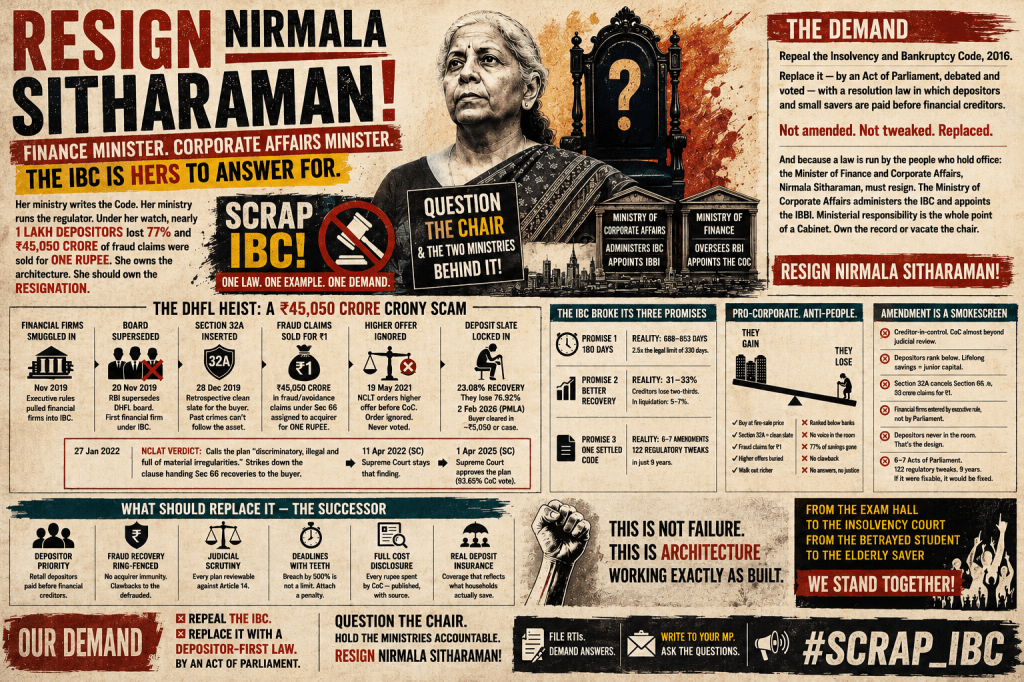
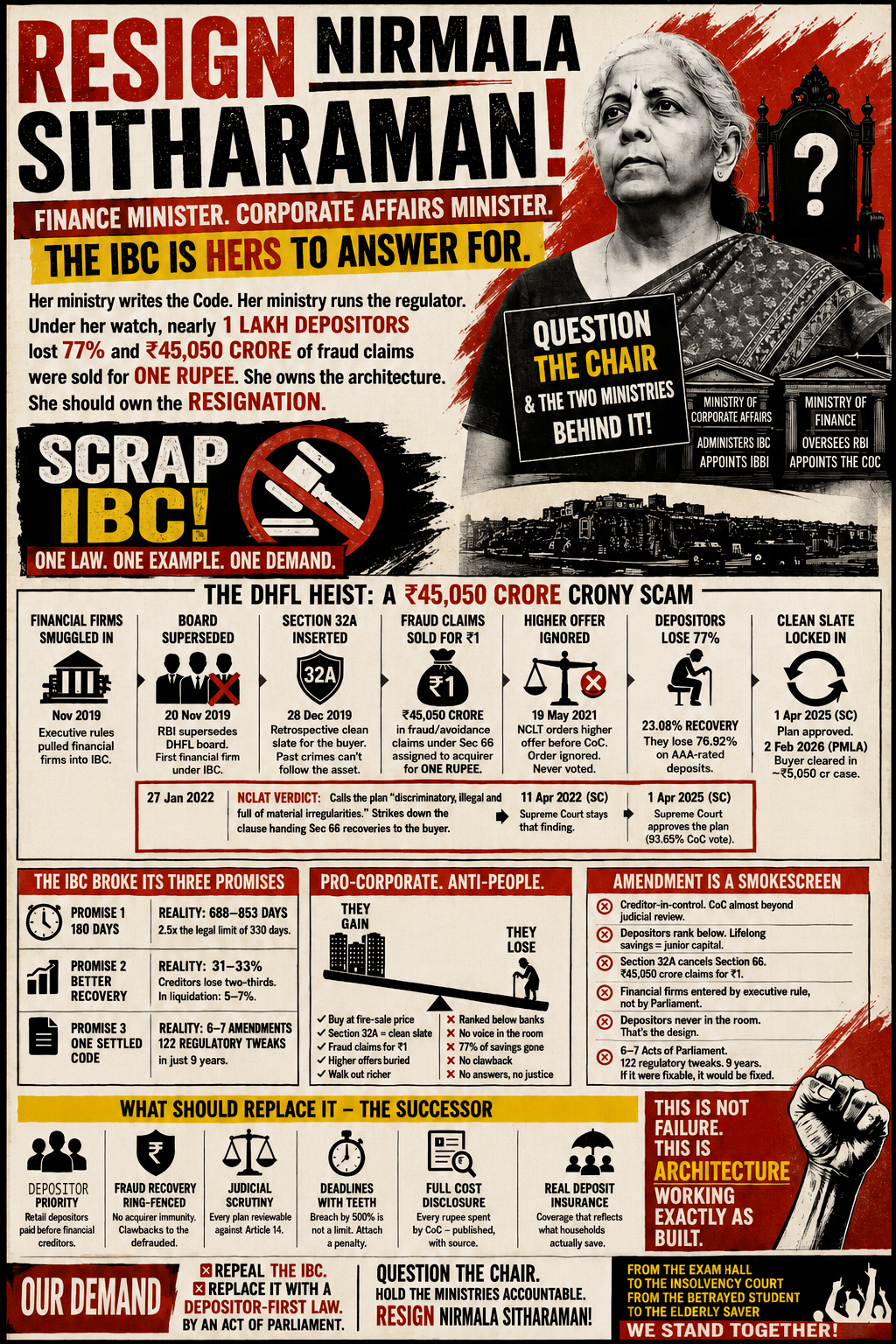
RESIGN NIRMALA SITHARAMAN!
Finance Minister. Corporate Affairs Minister. The IBC is hers to answer for.
Her ministry writes the Code. Her ministry runs the regulator. Under her watch, nearly 1 lakh depositors lost 77% and ₹45,050 crore of fraud claims were sold for one rupee. She owns the architecture. She should own the resignation.
SCRAP IBC!
One law. One example. One demand.
THE DEMAND
Repeal the Insolvency and Bankruptcy Code, 2016. Replace it — by an Act of Parliament, debated and voted — with a resolution law in which depositors and small savers are paid before financial creditors.
Not amended. Not tweaked. Replaced.
And because a law is run by the people who hold office: the Minister of Finance and Corporate Affairs, Nirmala Sitharaman, must resign. The Ministry of Corporate Affairs administers the IBC and appoints the IBBI. Ministerial responsibility is the whole point of a Cabinet. Own the record or vacate the chair.
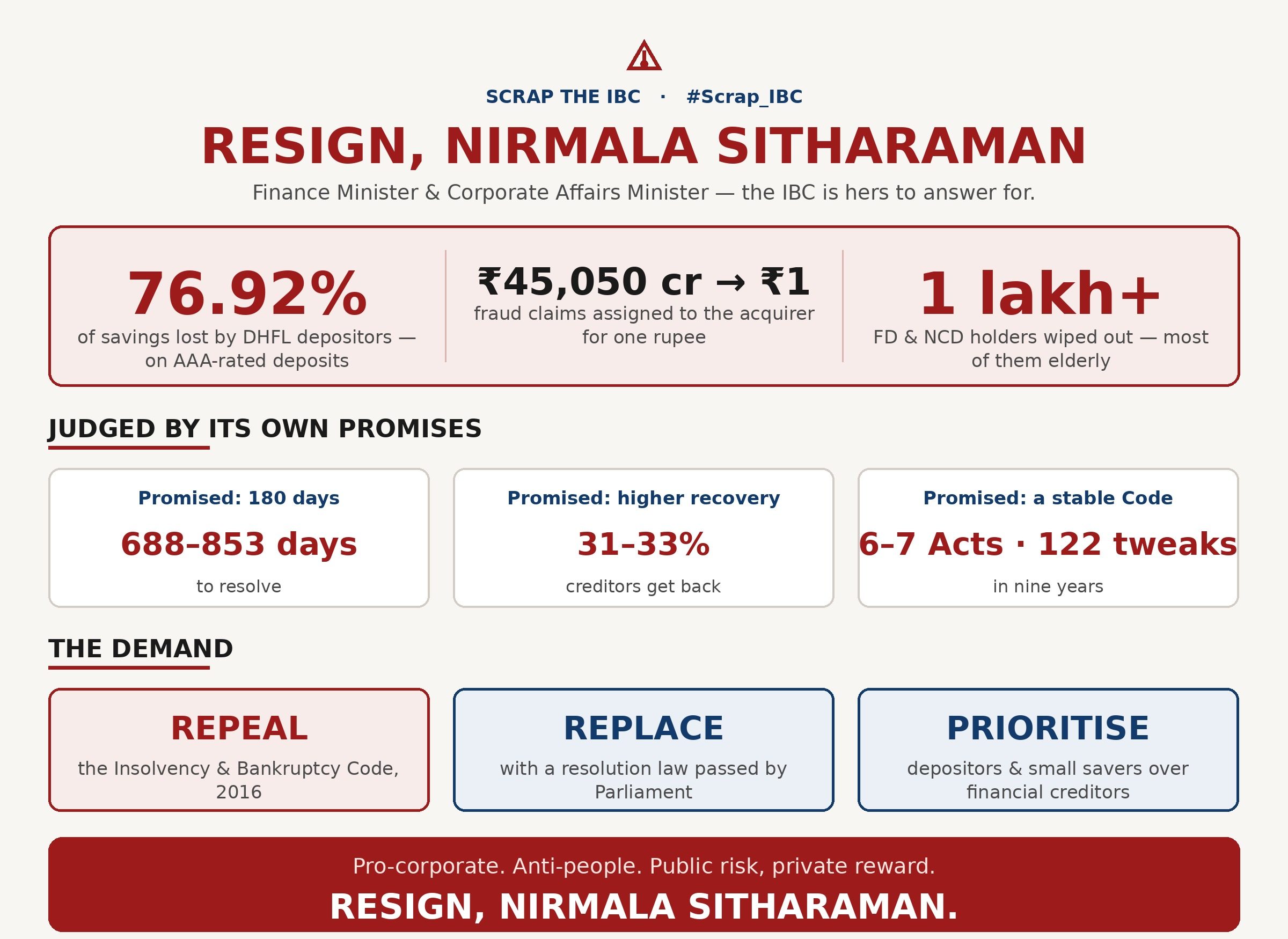
QUESTION THE CHAIR — AND THE TWO MINISTRIES BEHIND IT
Every step in the DHFL heist ran through offices held by the same Union government — and today, by the same minister.
The Ministry of Corporate Affairs writes and administers the IBC and appoints the IBBI, the regulator whose own data condemns it. The Ministry of Finance oversees the RBI, which drove the National Housing Bank → RBI handover, superseded DHFL’s board, and appointed the Committee of Creditors that cannot now say what it spent. Two ministries. One chair. Both portfolios sit with Nirmala Sitharaman. That is not a diffusion of blame. It is a concentration of it.
And the architect: the late Arun Jaitley. As Finance Minister he piloted the IBC through Parliament in 2016 and sold it as the reform that would end India’s bad-loan era — the Code’s deus ex machina, the hand that built the stage. He died on 24 August 2019, in the very weeks DHFL was collapsing into the machine he designed. The man is gone; the design is on trial. A law is not sacred because its author is dead. It is judged by what it does — and this one buried ₹45,050 crore of fraud claims for one rupee.
So we question the chair. Not the person — the office, and what the office did.
The Reserve Bank of India (RBI), under the authority of its Governor, drove the entire sequence: it assumed regulatory control of housing finance companies from the National Housing Bank in August 2019, superseded DHFL’s board on 20 November 2019, appointed the Administrator, and constituted the Committee of Creditors that later refused to place a higher-value offer before itself and still cannot account for a single rupee of its own expenditure. When RTIs seek the ledger of counsel fees, advisers and litigation reserves paid from the estate of nearly one lakh depositors who lost 77 percent, the RBI answers only by pointing elsewhere.
The RBI Governor’s office therefore stands in the same line of institutional responsibility as the dual ministries that designed and administered the Code. Own the process that the RBI itself initiated, or explain why the regulator that placed public savings into the insolvency machine now claims it maintains no data on what that machine spent.
JUDGE IT BY ITS OWN THREE PROMISES
Promise 1 — Resolution in 180 days. Reality: the IBBI’s own data shows resolutions averaging ~688 days per quarter, and 853 days for FY2025 closures. The statutory ceiling is 330 days. The law breaks its own limit by 2.5×.
Promise 2 — Better recovery. Reality: recovery stuck at 31–33% of admitted claims. Creditors lose two-thirds. The old regime returned 15–20%. Nine years for a marginal gain — and in liquidation, outcomes fall to 5–7%.
Promise 3 — One settled, one-stop Code. Reality: six to seven amendment Acts of Parliament (2017, 2018, 2019, 2020, 2021, 2026) and 122 regulatory tweaks — regulations, circulars and notifications — in under a decade. A Code re-legislated almost every year and re-cut 122 times below the surface is not adapting. It is confessing.
The haircuts are not accidents. They are the design. Videocon ≈ 96% · Aircel ≈ 89% · DHFL = 76.92%
THE ONE EXAMPLE: DHFL
Read it as a sequence. Every step is on the official or judicial record.
Financial firms were never meant to be here. Financial service providers were expressly excluded from the IBC when Parliament passed it in 2016.
Aug 2019 — Supervision of housing finance companies moves from the National Housing Bank to the RBI. DHFL collapses across the handover.
Nov 2019 — The Section 227 Financial Service Provider Rules are notified — delegated legislation Parliament never debated. By executive rule, financial firms are pulled inside a law that had shut them out.
20 Nov 2019 — The RBI supersedes DHFL’s board and sends it to the tribunal. DHFL becomes the first financial firm ever resolved under the Code — in the IBBI’s own words. Scale: ~₹90,000 crore; over one lakh FD and NCD holders (about 55,000–77,000 fixed-deposit holders alone), most of them elderly.
28 Dec 2019 — Section 32A enters by ordinance, 25 days into the process: a retrospective clean slate for whoever buys the company. Past offences cannot follow the asset.
The fraud, then the erasure. Forensic audit flags up to ₹45,050 crore in avoidance/fraud claims. Eight applications are filed under Section 66 — the clawback provision. Those claims are assigned to the acquirer for a consideration of ₹1.
19 May 2021 — the order that was ignored. The NCLT directs the Administrator to place the ex-promoter’s second settlement proposal — which claimed far higher value realisation for creditors — before the Committee of Creditors for consideration and a vote. On 25 May 2021 the NCLAT stays it; the CoC never puts it to a vote. On 7 June 2021 the Piramal plan is approved without it. An order of the tribunal, disobeyed — and a higher offer for the depositors, never counted.
The savers pay. Depositors recover 23.08% of ₹5,375 crore in admitted claims. They lose 76.92% — three rupees in every four — on money placed in a AAA-rated deposit.
The courts. 27 Jan 2022 — The NCLAT calls the plan “discriminatory, illegal and full of material irregularities” and strikes down the clause handing Section 66 recoveries to the buyer. 11 Apr 2022 — The Supreme Court stays that finding. 1 Apr 2025 — The Supreme Court approves the plan (93.65% CoC vote). It is now the law. 2 Feb 2026 — A PMLA court discharges the resurrected entity from a ~₹5,050 crore money-laundering case, citing Section 32A. The clean slate overrides even money-laundering liability.
The black hole. Asked under RTI what the RBI-appointed Committee of Creditors spent — counsel, advisers, litigation reserve — the RBI points to a nodal department, the IBBI says no such data is maintained, the CAG passes it in a circle. The regulator appointed the committee. The regulator cannot say what the committee spent. The money came from the estate of the people who lost 77%.
QUID PRO QUO? THE QUESTIONS THE RECORD FORCES
We ask. We assert no crime a court has not found. But a sequence this tidy is entitled to an explanation.
- A higher-value proposal for creditors was ordered before the CoC on 19 May 2021 — and never voted on. Who benefited from burying it, and who answers for the tribunal’s order being disobeyed?
- ₹45,050 crore of fraud claims was assigned to the winning bidder for ₹1, and every future recovery routed to that same bidder — not to the depositors the clawback exists to protect. Who fixed that price, and on whose authority?
- Section 32A was inserted by ordinance, 25 days into the DHFL process, and given retrospective effect — tailor-made to hand the eventual acquirer immunity. Convenient timing, or designed timing?
- The winning bidder — Ajay Piramal’s Piramal group — was cleared of a ~₹5,050 crore money-laundering case on the strength of that same Section 32A. Fraud acknowledged, investigated — then monetised to the buyer at token value and washed off the corporate record.
- The Piramal–BJP proximity is on the public record. Piramal Group entities purchased electoral bonds worth approximately ₹85–88 crore between 2019 and 2022 — every rupee of which was encashed by the Bharatiya Janata Party, the single largest beneficiary of the now-struck-down anonymous funding scheme. The same group also contributed ₹25 crore to the PM CARES Fund in 2020. We state the structural fact: the same establishment that wrote the rules (Ministry of Corporate Affairs), ran the process (RBI-appointed Committee of Creditors) and cleared the acquirer (Section 32A) is also the establishment that received the acquirer’s money. When the rule-writer, the referee and the donee are one and the same, the plain word for the arrangement is cronyism — public losses socialised through taxpayer-funded bank recapitalisation, private gains privatised to a chosen few.
These are questions. The government has the documents to answer them — and has, so far, answered with “no data maintained.” A hundred-per-cent evasion rate is itself an answer.
PRO-CORPORATE, ANTI-PEOPLE — WHO GAINS, WHO LOSES
Strip away the jargon and the IBC is a transfer machine with a direction of travel.
How the crony gains. A distressed empire is bought at a fire-sale price. Under Section 32A the buyer takes it scrubbed clean — past frauds, prosecutions and attachments cannot follow the asset. The fraud clawbacks that should refill the estate (₹45,050 crore in DHFL) are handed to that same buyer for ₹1, so even the proceeds of the looting become the buyer’s profit. Competing higher offers for creditors are left unvoted (19 May 2021). The acquirer emerges larger, cleaner and richer than the day it bid.
How the small depositor loses. The pensioner, the widow, the retired serviceman who put a life’s savings in a AAA-rated deposit is ranked below the banks, outside the room where the plan is decided, and handed 23 paise on the rupee as “full and final.” No priority. No vote that counts. No clawback. No clean answer on where the money went. Nearly 1 lakh families, 77% gone.
And who pays for the banks’ losses? The public. Public-sector banks absorb the two-thirds haircut and are recapitalised with taxpayer money. Losses are socialised across the people; gains are privatised to the few.
That is the whole design in four words: public risk, private reward. The IBC is pro-corporate and anti-people — not by an accident of drafting, but by the shape of its architecture. It was built to move distressed public wealth up to the connected, and to move loss down to the saver and the taxpayer. In DHFL it did exactly that.
WHY AMENDMENT CANNOT FIX THIS — FIVE DEFECTS OF ARCHITECTURE
1. Creditor-in-control. The Committee of Creditors decides. Since Essar Steel (2019), its “commercial wisdom” is placed almost beyond judicial review. A body that cannot be reviewed cannot be corrected.
2. Depositors rank below. Pensioners, widows, retired servicemen sit low in the waterfall, beneath financial creditors. A lifetime’s savings, treated as junior capital.
3. Section 32A cancels Section 66. One section chases the fraud; another erases its consequence. In DHFL, ₹45,050 crore of claims changed hands for ₹1.
4. Financial firms entered by executive rule. Not by statute. Not by debate. By notification. The insolvency of banks and housing finance companies is Parliament’s business — not a bureaucrat’s.
5. The depositors were never in the room. They weren’t outvoted; they were structured out. That is not a procedural failure. It is what the design specifies.
The 2026 Amendment Act touches none of these five. It adds a 14-day admission deadline, creditor-initiated resolution, and group-insolvency rules — and it strengthens the clean slate (new Sections 31(5)/(6)), making it retrospective to 2016. Speed, not justice. Worse: the same law that promises to keep fraud clawbacks alive still routes any recovery to the buyer, not the defrauded.
Six-to-seven Acts of Parliament. 122 regulatory tweaks. Nine years. If it were fixable by amendment, it would have been fixed by now.
| Year | Instrument | Major Change | Why It Matters |
|---|---|---|---|
| 2016 | IBC, 2016 (Parent Act) | Established CIRP, CoC, IBBI, Section 66, liquidation framework. | Only version subjected to full Joint Parliamentary scrutiny. |
| 2017–18 | 1st Amendment | Introduced Section 29A barring defaulting promoters from bidding. | Changed eligibility rules through an ordinance before parliamentary approval. |
| 2018 | 2nd Amendment | Homebuyers became financial creditors; CoC voting thresholds changed; Section 12A introduced. | Expanded creditor rights and reshaped insolvency voting. |
| 2019 | 3rd Amendment | Introduced 330-day timeline, strengthened CoC commercial wisdom, made plans binding on governments. | Became the framework governing later DHFL distributions. |
| Nov 2019 | Section 227 FSP Rules (Executive Rules) | Financial Service Providers brought under IBC through delegated legislation. | DHFL became the first FSP resolved under the Code without Parliament passing a new law. |
| 2019–20 | 4th Amendment | Introduced Section 32A granting immunity to successful acquirers after resolution. | Passed 25 days after DHFL entered CIRP; created the Section 32A–Section 66 architecture. |
| 2020 | 5th Amendment | Introduced Section 10A suspending COVID-era insolvency filings. | Pandemic-specific insolvency suspension. |
| 2021 | 6th Amendment | Introduced Pre-Pack Insolvency (PPIRP) for MSMEs. | Fifth consecutive amendment initially enacted through an ordinance. |
| 2025–26 | 7th Amendment | Group insolvency, cross-border framework, creditor-led resolution, revised approval process. | First amendment after 2016 to undergo meaningful committee scrutiny before enactment. |
| 2016–2026 | IBBI Regulations | 122+ regulatory amendments. | Much of the operational law evolved through regulator-made rules rather than parliamentary legislation. |
WHAT WE ARE OPENLY CALLING OUT
• Big Bank-centric decision-making through the Committee of Creditors
• Large-creditor / corporate-oriented resolution framework
• Limited protection for retail depositors and small savers
• Broad deference to CoC so-called “commercial wisdom”, even by undermining due process
• Extensive reliance on ordinances (easy transformation of bills into acts without deliberation/discussion), delegated legislation, and hundreds of regulatory amendments after 2016 (inception).
WHAT SHOULD REPLACE IT — THE SUCCESSOR
A repeal without a successor is a slogan. Here is the successor.
- A dedicated financial-firm resolution statute — passed by Parliament, referred to committee, debated, voted. Not delegated rules.
- Depositor priority. Retail depositors and small savers paid before financial creditors. They are savers, not risk investors.
- Fraud recovery ring-fenced. Where fraud is judicially found, no acquirer immunity may extinguish it. Clawbacks flow to the defrauded — never to the buyer of the asset.
- Judicial scrutiny restored. Every plan reviewable against Article 14. “Commercial wisdom” cannot be a zone the Constitution does not reach.
- Deadlines with teeth. A limit breached by 500% is not a limit. Attach a penalty.
- Full cost disclosure. Every rupee a resolution committee spends — published, with its source. The estate belongs to the creditors; they are owed the ledger.
- Real deposit insurance. Cover that reflects what Indian households actually keep in a fixed deposit.
ALREADY ON THE RECORD — CITE WITHOUT QUALIFICATION
Two findings made by tribunals, not by us:
- NFRA (Dec 2023 & Jun 2024) investigated the DHFL audits, recorded serious misconduct across five branches, imposed penalties, and debarred chartered accountants.
- Chandigarh State Consumer Commission (31 Jul 2025) held a debenture trustee and two credit-rating agencies liable for deficiency in service, finding the agencies in “flagrant violation” of their duties under the SEBI (Credit Rating Agencies) Regulations, 1999 — they had held DHFL at AAA until effectively the day of default.
One investor won that case. Every other depositor can bring the same claim.
WHAT YOU CAN DO
- DHFL depositors / NCD holders: the Khemka precedent is yours. Consumer-commission claims against the trustee and the rating agencies are live, cheap, and have already succeeded once.
- File RTIs — on the CoC’s expenditure, the avoidance applications, the audit reports. A 100% evasion rate is itself evidence. Collect it.
- Write to your MP. Two questions: why did financial firms enter the Insolvency Code by executive notification and not by an Act of Parliament? And why was the NCLT’s 19 May 2021 order to consider a higher offer for depositors simply ignored?
- Circulate this. Print it. Paste it. It is free to reproduce.
THE POINT
A law that misses its own deadline by 500%. A law that returns a third of what is owed. A law amended by Parliament six to seven times — and re-cut 122 times by regulation — in nine years. A law that let ₹45,050 crore of fraud claims change hands for one rupee. A law that ignored a tribunal’s order to weigh a better offer for its victims. A law under which nearly 1 lakh elderly savers lost 77% — and no one will say what the committee that did it spent.
This is not a law that failed. This is a law working exactly as it was built to work.
Scrap it. Replace it. Question the chair and the two ministries behind it. And the minister who owns it today —
RESIGN, THE MINISTER OF FINANCE AND CORPORATE AFFAIRS!
SCRAP IBC!